


<p>Office of Public Affairs</p>
Official websites use .gov
A .gov website belongs to an official government organization in the United States.
Secure .gov websites use HTTPS
A lock
()
or https:// means you’ve safely connected to the .gov website. Share sensitive information only on official, secure websites.
OPA
 Indian Affairs - Office of Public Affairs
TO: Indian Country Reporters
FROM: U.S. Dept. of the Interior Communications Office
DATE: December 2016
RE: U.S. Department of the Interior Tribal Nations Accomplishments
Today, U.S. Secretary of the Interior Sally Jewell will begin a nationwide tour to highlight the progress the nation has made over the last eight years on public lands, waters and wildlife management and restoring nation-to-nation relationships with Native Americans.
As part of President Obama’s commitment to strengthening Indian Country, Secretary Jewell will visit the Acoma Pueblo, west of Albuquerque, today, to highlight Administration efforts to strengthen tribal nations. She will be joined by the newly-appointed Bureau of Indian Affairs Director Bruce Loudermilk and Bureau of Indian Education (BIE) Director Tony Dearman.
From the beginning, President Obama has made it a top priority to help bring real and lasting change to Indian Country and to open a new chapter with First Americans. In close consultation with Native Americans and Alaska Natives, the Obama Administration is delivering on its promise to restore the integrity of the nation-to-nation relationship with Indian Country.
The Interior Department has played a leading role in empowering tribal nations, with self-governance and self-determination serving as the foundation for every effort. Over the past (nearly) eight years, the Interior Department has accelerated the restoration of tribal homelands, improved public safety in tribal communities, resolved century-old water disputes, made critical investments in education, and reached many more milestones that are helping tribal nations pursue a future of their choosing.
Secretary Jewell, as the first Chair of the White House Council on Native American Affairs, has helped ensure that the federal family has regular and meaningful engagement on the key issues that impact Indian Country. In her nearly four years in office, Jewell has visited more than 40 tribes across the country.
For background and reporting purposes, here’s a snapshot of the Interior Department’s work in Indian Country:
Advancing Self-Determination and Self-Governance
- Developed a tribal consultation policy for the Department of the Interior, emphasizing trust, respect and a shared responsibility in providing tribal governments an expanded role in informing federal policy that impacts Indian Country
- Engaged in meaningful consultation with tribal leaders through the first-ever White House Tribal Nations Conferences
- The Interior Department helped host the annual conference, an opportunity for leaders from the 567 federally recognized tribes to interact directly with the President and high-level federal government officials
- Chaired the White House Council on Native American Affairs, established in 2013 by President Obama
- Under Secretary Jewell’s leadership, and in consideration of tribal feedback, the Council created five interagency subgroups in the areas of: economic development and infrastructure; education; energy; environment and climate change; and health
- The Council facilitates engagement with tribes, recently inviting the President of the National Congress of American Indians to address the Council to begin more direct engagement with tribal leaders
- Forged an agenda of reconciliation and empowerment for Indian Country, seeking to end decades of litigation and long-standing disputes through fair trust settlements
- The Administration has settled a record number of lawsuits or claims related to mismanagement of monetary assets and natural resources held in trust, some of the claims dating back more than 50 years
- In Ramah Navajo Chapter v. Jewell, for example, the Department of Justice and Interior reached a $940 million proposed settlement agreement with tribes and tribal organizations to resolve a 25-year-old legal dispute related to contract support costs.
- Reached an historic $3.4 billion settlement in Cobell v. Salazar - the largest class action lawsuit in American history - to settle decades of tribal trust mismanagement throughout Indian Country
- Established the National Commission on Indian Trust Administration and Reform to undertake a forward-looking, comprehensive evaluation of Interior's trust management of nearly $4 billion in Native American trust funds
- Created the Land Buy-Back Program for Tribal Nations to consolidate fractional land interests across Indian Country and unlock economic development
- Since it began making offers in December 2013, the Program has paid more than $900 million to individual landowners and restored the equivalent of more than 1.7 million acres of land to tribal governments
- As a result, tribes have been able to advance important projects:
- Community water supply plant (Crow Tribe)
- Housing and economic development (Oglala Sioux Tribe of the Pine Ridge Reservation)
- Cultural renewal and burial ground expansion (Confederated Tribes of the Umatilla Indian Reservation)
- Formed the Indian Education Scholarship Fund which has provided $4.5 million for higher learning opportunities for Native youth
- Reenergized a commitment to meeting the critical water needs of Native American communities
- Finalized six landmark water rights settlements that will help deliver clean running water and fair water allocations to Native American communities - many for the first time. The permanent water supply will vastly improve quality of life and offer greater economic security
- Two additional water rights settlements and another amendment to implement a previously enacted settlement is currently pending in Congress; all of which the Administration supports
- Announced a policy to identify and encourage opportunities for cooperative management of public lands and waters that have a nexus to historic tribal lands and instituting the first actual agreement with the AHTNA Intertribal Resource Commission to create a cooperative wildlife management demonstration project.
- For the first time ever, formalized a path forward by which the Native Hawaiian community could seek a government-to-government relationship with the United States
- Reformed broken federal recognition process to establish a more transparent, timely and consistent process by which the Interior Department may formally recognize Indian tribes
Restoring Tribal Homelands
- Broke the logjam on trust land applications to restore tribal homelands and strengthen tribal economies
- Since 2009, the Bureau of Indian Affairs (BIA) has processed thousands of trust applications and restored more than 542,000 acres of land into trust, exceeding the goal of reaching 500,000 acres by the end of the current administration
- Finalized a rule to allow the Interior Department to accept land into trust for federally recognized Alaska tribes, thereby advancing tribal sovereignty and closing a long-standing gap that had not extended this eligibility to Alaska Natives
- Provided tribes greater control over their homelands by overhauling antiquated leasing regulations
- Streamlined surface leasing regulations for Indian lands that had bottlenecked applications to build homes, businesses and wind and solar projects
- Provided tribes the authority to approve and manage leases on their trust lands without BIA approval, through the Helping Expedite and Advance Responsible Tribal Homeownership Act of 2012 (HEARTH Act) and its voluntary, alternative land leasing process
- Expanded leasing provisions to give Indian landowners greater control to obtain BIA grants of rights-of-way on Indian land, including for roads, power lines, or water lines
Empowering Native Youth
- Worked collaboratively, as part of the Obama Administration’s Generation Indigenous (Gen-I) initiative, to remove barriers between Native youth and opportunities to succeed
- Spearheaded the Tiwahe Initiative, designed to promote the stability and security of Native American families by addressing interrelated issues associated with child welfare, poverty, domestic violence, substance abuse and incarceration
- Finalized rule to implement the Indian Child Welfare Act (ICWA) to protect the rights of Indian children, their parents and their tribes in state child welfare proceedings
- Made steady progress toward improving the delivery of education to Indian children
- Obtained funding to rebuild and improve Bureau of Indian Education (BIE) schools in the most dilapidated conditions; identified new priority schools that are eligible for funding for campus-wide replacement
- Instituted a transformation of the BIE, with the goal of supporting tribal control of student education and turning BIE from a direct operator of schools into a support system for student achievement and administrative success.
Indian Affairs - Office of Public Affairs
WASHINGTON – U.S. Secretary of the Interior Sally Jewell, Deputy Secretary Mike Connor and other senior Interior Administration officials will embark on a two-week nationwide tour to highlight progress the nation has made during the last eight years to: protect our nation’s lands, waters and wildlife; restore the nation-to-nation relationship with Native Americans and Alaska Natives; engage the next generation; and invest in sound science to inform decisions related to energy development, conservation and our changing climate.
Thursday, December 8
Strengthening Tribal Nations (New Mexico and Washington State)
In her final visit to Indian Country, Secretary Jewell will join newly appointed Bureau of Indian Affairs Director Bruce Loudermilk and Bureau of Indian Education (BIE) Director Tony Dearman at the Acoma Pueblo in New Mexico. Loudermilk and Dearman are career civil servants that will help carry on the Obama Administration’s commitment to restore tribal homelands and improve outcomes for Native youth.
Secretary Jewell will tour the Pueblo where the Obama Administration recently restored more than 59,000 acres of land into trust for the benefit of the tribe. She will also talk to students and teachers at the Pueblo’s Sky City School that is transitioning from a BIE-operated school to one that is controlled by the Tribe.
Also on Thursday, Deputy Secretary Connor will visit the Swinomish Indian Tribal Community in Washington where he will make an announcement related to tribal self-determination and economic development.
Friday, December 9
Protecting America’s Natural and Cultural Heritage (Las Cruces, New Mexico)
Secretary Jewell will join community members to celebrate the Organ Mountains-Desert Peaks National Monument, designated by President Obama in 2014 as part of the Bureau of Land Management’s National Conservation Lands. President Obama has protected more lands and waters than any President in history.
Secretary Jewell and Las Cruces Green Chamber of Commerce CEO/President Carrie Hamblen will host a roundtable with business and community leaders to discuss the economic benefits that healthy and protected public lands provide to local communities, as well as the ongoing work to expand access to the outdoors for diverse communities.
Tuesday, December 13
Building a Sustainable Energy Future
Secretary Jewell will announce new steps to support renewable energy, both on public lands and offshore waters. Over the past eight years, Interior has established an enduring renewable energy program and permitted 60 wind, solar and geothermal projects that, when built, could power five million American homes.
Wednesday, December 14
Taking Action on Climate Change (San Francisco, CA)
Secretary Jewell will deliver keynote remarks at the American Geophysical Union’s Fall Meeting in San Francisco. Secretary Jewell will discuss the critical role that science has played in the President’s historic Climate Action Plan and offer thoughts on continued need for transparent, independent and sound science to guide policy in the next administration.
Ensuring Healthy Watersheds (Las Vegas, NV)
Secretary Jewell and Deputy Secretary Connor will attend the annual Colorado River Water Users Association Conference in Las Vegas, Nevada where they will discuss how Interior is meeting the water challenges of our time by pursuing new, creative ideas and solutions that address the effects of climate change on water resources, improve drought resiliency and long-term water management strategies, and help to ensure stable and secure water supplies for future generations. Secretary Jewell will make an important announcement regarding Glen Canyon Dam.
Thursday, December 15
Engaging the Next Generation (Austin, TX)
Secretary Jewell will make a major announcement in Austin related to the Interior Department’s efforts to inspire millions of kids to play, learn, serve and work outdoors. Through investing in opportunities to get young people outside, Interior is bridging the growing disconnect between kids and nature and engaging the next generation to be stewards of our land, water and wildlife.
Additional logistical details will be provided in the coming days.
Indian Affairs - Office of Public Affairs
OKLAHOMA CITY, Okla. – At a signing ceremony today, U.S. Secretary of the Interior Ryan Zinke approved the Shawnee Tribe’s application to put 102.98 acres of land in Guymon, Texas County, Oklahoma, into federal Indian trust status for gaming. The Shawnee Tribe proposes to develop a 42,309-square foot gaming facility on the site comprised of a 20,206-square foot gaming floor, a restaurant, retail space, and office spaces for the Shawnee Tribe Gaming Commission. When completed, the project is expected to generate a $30 million annual impact for the local economy, including creating 200 permanent jobs. The federally recognized tribe, landless for well over 160 years, is headquartered in Miami, Okla., and has approximately 2,500 members.
“One of my top priorities for the Department of the Interior is to make tribal sovereignty meaningful, and that includes providing the basis for tribes to build and strengthen their economies,” Secretary Zinke said. “This gaming facility will create 200 jobs and bring in $30 million annually to the Tribe.”
“I want to thank Secretary Zinke for approving the Shawnee Tribe’s application to put land into trust, which will provide the Shawnee people with their first land base in well over a century,” said Shawnee Tribe Chief Ron Sparkman. “We’ve worked hard to set ourselves on the path to a better future, and this project will help us achieve our goals of tribal self-sufficiency through economic progress.”
“It is fitting we follow the acknowledgement by Congress to offer the Shawnee Tribe the ability to self-determination and self-governance by allowing economic development opportunities,” said Governor Mary Fallin. “I concur with the secretary of the interior’s determination that the Shawnee Tribe’s proposal will provide economic development to the Guymon and surrounding area. This will also benefit the Shawnee Tribe in helping it develop a funding source as it works toward self-determination and self-governance.”
“Federally recognized tribes should be able thrive and serve as steadfast contributors to our economy, and I am confident that the Shawnee Tribe will do so with their proposal,” said Congressman Tom Cole. “I’d like to thank Secretary Zinke for leading this effort, and for being at the forefront of recognizing self-governance and sovereignty among Native American tribes. Indian Country has been successful in exercising its sovereignty through its enterprises and this proposal is a clear example of that right.”
“I congratulate Chief Sparkman, the Shawnee tribal council, and tribal members for achieving this important goal,” said John Tahsuda, Interior’s principal deputy assistant secretary for Indian Affairs. “Their efforts to create greater economic prosperity for themselves and their future generations, combined with the approval of their fee-to-trust application, underscore the Secretary’s determination that tribal sovereignty must mean something.”
The Tribe’s application was considered under the Secretary’s authority to acquire the land in trust for it under the Shawnee Status Act of 2000 through the Indian Reorganization Act of 1934.
The application met the Department’s requirements for placing land into trust for gaming, despite the proposed site’s location being approximately 370 miles west of the Tribe’s headquarters in Ottawa County, and the Department received comments in support of the proposed project.
Oklahoma Governor Mary Fallin, concurring with the Department’s positive two-part determination on the application, called for the expedient acquisition of the site into trust. Local officials supporting the application include a Texas County commissioner and the mayor of Guymon.
It was also supported by several Oklahoma tribes including the Cherokee Nation, the Eastern Shawnee Tribe, the Miami Tribe, the Modoc Tribe, the Ottawa Tribe of Oklahoma, the Peoria Tribe of Indians, the Quapaw Tribe, the Seneca-Cayuga Nation, and the Wyandotte Nation.
Until the Secretary’s approval of its land-into-trust for gaming application, the Shawnee Tribe had been landless since the mid-19th century, when the 1854 Treaty of Washington terminated the Tribe’s 1.6 million-acre reservation in Kansas, which had been created under earlier treaties, allotted approximately 200,000 acres to individual Indians, and opened the majority of the remaining lands to non-Indian settlement. In 1869, the United States relocated the Shawnee tribal members in Kansas, known as the Loyal Shawnee because of their service to the Union during the Civil War, to present-day Oklahoma, but did not provide the tribe with its own land base.
In 2000, Congress passed the Shawnee Status Act which reaffirmed the Tribe’s federal recognition status. That act also confirmed the Tribe’s eligibility to have land acquired in trust, but prohibits it from acquiring trust land within the jurisdiction of the Cherokee Nation or any other tribe without its consent. The Cherokee Nation’s constitution prohibits it from consenting to any action that would diminish its jurisdiction.
Because of the act’s limitations, the only place the Shawnee Tribe can effectively acquire trust land is in the Oklahoma Panhandle.
###
Indian Affairs - Office of Public Affairs
WASHINGTON – President Donald Trump today proposed a $2.4 billion Fiscal Year (FY) 2019 budget for Indian Affairs, which includes the Bureau of Indian Affairs (BIA), and the Bureau of Indian Education (BIE) led by the Assistant Secretary – Indian Affairs.
The budget request includes proposed legislation to establish a Public Lands Infrastructure Fund that would take new revenue from federal energy leasing and development to provide up to $18 billion to help pay for repairs and improvements at Bureau of Indian Education funded schools, national wildlife refuges and national parks.
“President Trump is absolutely right to call for a robust infrastructure plan that rebuilds our national parks, refuges, and Indian schools, and I look forward to helping him deliver on that historic mission,” said U.S. Secretary of the Interior Ryan Zinke. “Our Parks and Refuges are being loved to death, but the real heart break is the condition of the schools in Indian Country. We can and must do better for these young scholars. This is not a republican or democrat issue, this is an American issue, and the President and I are ready to work with absolutely anyone in Congress who is willing to get the work done.”
“As our Indian schools are in desperate need of repair, it is reassuring that the President’s budget calls for a real way to fix them through the proposed Public Lands Infrastructure Fund,” said Principal Deputy Assistant Secretary – Indian Affairs John Tahsuda. “This budget prioritizes improving the infrastructure that will create a stronger foundation from which we deliver our programs to tribal communities. This will allow us to continue to restore trust with them and ensure that sovereignty regains its meaning.”
Indian Affairs plays an important role in carrying out the Federal government’s trust, treaty and other responsibilities to the nation’s 573 federally recognized American Indian and Alaska Native tribes, which have, in total, a service population of nearly two million American Indians and Alaska Natives in tribal communities nationwide. The FY 2019 Indian Affairs budget proposal supports continuing efforts to advance self-governance and self-determination, fosters stronger economies and self-sufficiency, and supports safe Indian communities through a wide range of activities.
Budget Overview – The 2019 President’s budget for Indian Affairs is $2.4 billion in current appropriations.
Public Lands Infrastructure Fund – The BIE manages a school system of 169 elementary and secondary schools and 14 dormitories providing educational services to 47,000 individual students in 23 States. Although many of the schools are tribally controlled and operated by the Tribes, BIE is responsible for oversight and the maintenance of the school facilities. The estimated deferred maintenance backlog for BIE schools is $634 million, which does not include the cost of replacement for the schools in the worst condition. The Administration proposes legislation in the FY 2019 budget to establish the Public Lands Infrastructure Fund to provide up to $18.0 billion to address needed repairs and improvements in the BIE schools, as well as the national parks and national wildlife refuges.
Construction – The FY 2019 budget prioritizes rehabilitation of dams, irrigation projects, and irrigation systems which deliver water to aid tribal economic development as well as protect lives, resources, and property. The Safety of Dams program is currently responsible for 138 high or significant-hazard dams located on 43 Indian reservations. The irrigation rehabilitation program addresses critical deferred maintenance and construction work on BIA-owned and operated irrigation facilities, including 17 irrigation projects.
The request also prioritizes construction related to regional and agency offices serving tribal programs and operations in Indian Country including the upgrade and repair of telecommunications infrastructure and facilities housing BIA and tribal employees providing services to Indian Communities.
In addition to support through the Public Lands Infrastructure Fund, the budget proposes funding for Education Construction focusing on facility improvement and repair at existing schools. Available funding from prior years will continue work to complete school construction on the 2004 school replacement list and proceed with design and construction for schools on the 2016 school replacement list.
Contract Support Costs – The FY 2019 budget maintains the Administration’s support for the principles of tribal self-determination and strengthening tribal communities across Indian Country. The request fully supports the estimated need for Contract Support assuming BIA program funding at the FY 2019 request. The FY 2019 budget continues to request funding for Contract Support Costs in a separate indefinite current account to ensure full funding for this priority.
Land and Water Claims Settlements – The FY 2019 budget prioritizes funding to meet Indian Settlement commitments and enables the Department to meet Federal responsibilities outlined in enacted settlements with Indian Tribes. Settlements resolve tribal land and water rights claims and ensure Tribes have access to land and water to meet domestic, economic, and cultural needs. Many of the infrastructure projects supported in these agreements improve the health and well-being of tribal members and preserve existing economies and, over the long-term, bring the potential for jobs and economic development. The FY 2019 budget includes $45.6 million, including sufficient funding to complete payments for the Navajo Trust Fund and the Navajo-Gallup Water Supply Project, both of which have enforceability dates in 2019.
Operation of Indian Programs – The FY 2019 budget requests $2.0 billion for the Operation of Indian Programs giving priority to base program funding serving tribal communities across Indian Country. The budget reflects Department-wide efforts to identify administrative savings and identifies $8.3 million in administrative savings attained by consolidating and sharing administrative services such as procurement, information technology, human resources, and by shifting acquisition spending to less costly contracts. The budget also includes $900,000 to support the Department’s migration to common regional boundaries to improve service and efficiency. The Department will hold a robust consultation process with tribal nations before actions are taken with respect to Indian Affairs regions.
Promote Tribal Self-Determination – The BIA Tribal Government activity supports assistance to Tribes and Alaska Native entities to strengthen and sustain tribal government systems and support tribal self-governance through the Public Law 93-638 contracting and compacting process.
The FY 2019 budget requests $291.5 million for programs that support Tribal Government activities. Within this, the budget includes:
- $157.8 million for self-governance compact activities for self-governance Tribes.
- $72.6 million to support Consolidated Tribal Government programs which also promote Indian self-determination, giving approximately 275 Tribes the flexibility to combine and manage contracted programs and grants.
- Funding to provide initial Federal support for six Virginia Tribes federally-recognized by a 2018 Act of Congress, including the Chickahominy, the Eastern Chickahominy, the Upper Mattaponi, the Rappahannock, the Monacan, and the Nansemond. Each tribe in the request would receive $160,000 to begin establishing and carrying out the day-to-day responsibilities of a tribal government.
- $28.3 million for Road Maintenance to support pavement and gravel maintenance, remedial work on improved earth roads, bridge maintenance, and snow and ice control. The BIA maintains nearly 29,000 miles of paved, gravel and earth surface roads; and more than 900 bridges.
Protect Indian Country – The BIA’s Office of Justice Services (OJS) funds law enforcement, corrections and court services to support safe tribal communities. These programs safeguard life and property, enforce laws, maintain justice and order, and ensure detained American Indian offenders are held in safe, secure, and humane environments. The 2019 budget prioritizes funding for the primary law enforcement and corrections programs, and identifies savings to minimize impacts on these critical programs.
The FY 2019 budget requests $350.1 million for Public Safety and Justice activities:
- $326.7 million supports 190 law enforcement programs and 96 corrections programs run both by Tribes and as direct services.
- $2.5 million targeted to address the opioid crisis which has been particularly devastating in Indian Country.
- $22.1 million for Tribal Courts.
Support Indian Communities – Sustaining families is critical to fostering thriving Indian communities. The BIA Office of Indian Services supports a community-based approach to child welfare, family stability, and strengthening tribal communities as a whole.
The FY 2019 budget requests $115.4 million for Human Services programs:
- $46.6 million for Social Services and Indian Child Welfare Act programs.
- $65.8 million for Welfare Assistance.
Manage Trust Resources and Lands – The BIA Trust-Natural Resources Management activity supports the stewardship of trust lands in Indian Country. Natural resource programs assist Tribes in the management, development, and protection of Indian trust land and natural resources on 56 million surface acres and 59 million acres of subsurface mineral estates. These programs enable tribal trust landowners to optimize use and conservation of resources, providing benefits such as revenue, jobs, and the protection of cultural, spiritual, and traditional resources.
The FY 2019 budget requests $153.4 million for natural resource management programs which includes agriculture, forestry, water resources, and fish, wildlife and parks activities, including:
- $48.9 million for BIA Forestry programs to support development, maintenance, and enhancement of forest resources in accordance with sustained yield principles included in forest management plans; and
- $28.0 million for BIA’s Agriculture and Range program to continue support for multiple use and sustained yield management on over 46 million acres of Indian trust land dedicated to crop and livestock agriculture; and
- $11.4 million for Fish, Wildlife and Parks and $8.6 million for Water Resources management activities.
Keep Fiduciary Trust Responsibilities – The Trust-Real Estate Services activity manages Indian trust-related information to optimize the efficacy of Indian trust assets. The 2019 budget proposes $105.5 million for real estate services programs. The budget supports the processing of Indian trust-related documents such as land title and records and geospatial data to support land and water resources use, energy development, and protection and restoration of ecosystems and important lands. The budget also funds probate services to determine ownership of Indian trust assets essential to economic development and accurate payments to beneficiaries.
Support Economic Opportunities – The FY 2019 budget requests $35.8 million for the Community and Economic Development activity, and features investments in Indian energy activities. The FY 2019 budget supports the Administration’s priority for domestic energy dominance and economic development, including development on tribal lands. Income from energy and minerals production is the largest source of revenue generated from natural resources on trust lands, with royalty income of $676.0 million in 2017 payable to tribal governments and individual mineral rights owners. The FY 2019 budget continues the commitment to the Indian Energy Service Center which coordinates Indian energy development activities across Interior’s bureaus.
Foster Tribal Student Success – The FY 2019 budget prioritizes funding for core mission programs at BIE-funded elementary and secondary school operations and Post-Secondary tribal colleges and universities. The budget focuses on direct school operations including classroom instruction, student transportation, native language development programs, cultural awareness and enrichment, and school maintenance. In some remotely located schools, funding also supports residential costs.
The FY 2019 budget requests $741.9 million for Bureau of Indian Education programs:
- $625.9 million for Elementary and Secondary programs, including $74.0 million for Tribal Grant Support Costs for Tribes which choose to operate BIE-funded schools. This level will support 100 percent of the estimated requirement.
- $92.7 million for Post-Secondary programs.
- $23.3 million for Education Management.
Tribal Priority Allocations – The 2019 budget proposes Tribal Priority Allocation funding of $578.7 million.
Indian Guaranteed Loan Program – In order to make Indian business financing more readily available, this program offers loan guarantees and insurance covering up to 90 percent of outstanding loan principal to Indian tribes, tribal members, or for profit and not-for-profit businesses at least 51 percent Indian owned. The FY 2019 budget requests $6.7 million to guarantee or insure $108.6 million in loan principal to support Indian economic development.
Fixed Costs – Fixed costs of $9.7 million are fully funded.
The Assistant Secretary–Indian Affairs advises the Secretary of the Interior on Indian Affairs policy issues, communicates policy to and oversee the programs of the BIA and the BIE, provides leadership in consultations with tribes, and serves as the DOI official for intra- and inter- departmental coordination and liaison within the Executive Branch on Indian matters.
The Bureau of Indian Affairs’ mission includes developing and protecting Indian trust lands and natural and energy resources; supporting social welfare, public safety and justice in tribal communities; and promoting tribal self-determination and self-governance.
The Bureau of Indian Education implements federal Indian education programs and funds 183 elementary and secondary day and boarding schools (of which two-thirds are tribally operated) located on 64 reservations in 23 states and peripheral dormitories serving over 47,000 individual students. The BIE also operates two post-secondary schools and administers grants for 29 tribally controlled colleges and universities and two tribal technical colleges.
###
Indian Affairs - Office of Public Affairs
WASHINGTON, D.C. | U.S. Secretary of the Interior Ryan Zinke is confirmed to attend the National Congress of American Indians (NCAI) 2017 Mid Year Conference & Marketplace (Mid Year) at Mohegan Sun in Uncasville, Connecticut held from Monday, June 12 to Thursday, June 15, 2017.
“We are looking forward to hosting Secretary Zinke during NCAI Mid Year,” said NCAI President Brian Cladoosby. “This year’s theme ‘Sovereign Infrastructure: Building our Communities through our Values’ is an important conversation we will continue to build upon with the Department of the Interior and the Administration in the years to come.”
“It is a great honor to accept the invitation to speak at NCAI’s Mid Year Conference,” said Secretary Ryan Zinke. “This will give tribal leaders and I an opportunity to discuss ways to empower the front lines of tribal communities. I am a supporter of building a stronger government-to-government relationship that will reaffirm tribal sovereignty, self-determination and self-governance in Indian Country.”
As the fifty-second U.S. Secretary of the Interior, Zinke leads more than 70,000 employees who supervise 20 percent of the nation’s lands, including national parks, monuments, wildlife refuges and other public lands. The Department of the Interior (DOI) oversees the responsible development of conventional and renewable energy supplies on public lands and waters; is the largest supplier and manager of water in the 17 Western states; and upholds trust responsibilities to the 567 federally recognized American Indian and Alaska Native tribes.
Prior to his position as DOI Secretary, Zinke represented the state of Montana in the U.S. House of Representatives from 2014 to 2016, and in the Montana State Senate from 2009 to 2011.Secretary Zinke is a fifth-generation Montanan and former U.S. Navy SEAL Commander, in which he spent 23 years as a U.S. Navy SEAL officer.
Pre-register today for press credentialing using our form here: bit.ly/2raRr8a.
On-site press credentialing takes place on Tuesday, June 13, 2017 and Wednesday, June 14, 2017 from 7:30 AM EST – 5:00 PM EST. Credentialed press will have access to all plenary sessions, as well as those sessions noted for press access on the agenda.
Please note all press are required to wear press badges at all times and are asked to please announce yourself to the moderator of each session you plan on attending.
For additional information, please view NCAI’s 2017 Mid Year Draft Agenda here or contact NCAI Communications Associate Erin Weldon with any questions at ncaipress@ncai.org.
###
About The National Congress of American Indians:
Founded in 1944, the National Congress of American Indians is the oldest, largest and most representative American Indian and Alaska Native organization in the country. NCAI advocates on behalf of tribal governments and communities, promoting strong tribal-federal government-to-government policies, and promoting a better understanding among the general public regarding American Indian and Alaska Native governments, people and rights. For more information, visit www.ncai.org.
Indian Affairs - Office of Public Affairs
Alaska Daily News: "The White House announced the pick Monday. The reaction on Tuesday bordered on ecstatic"
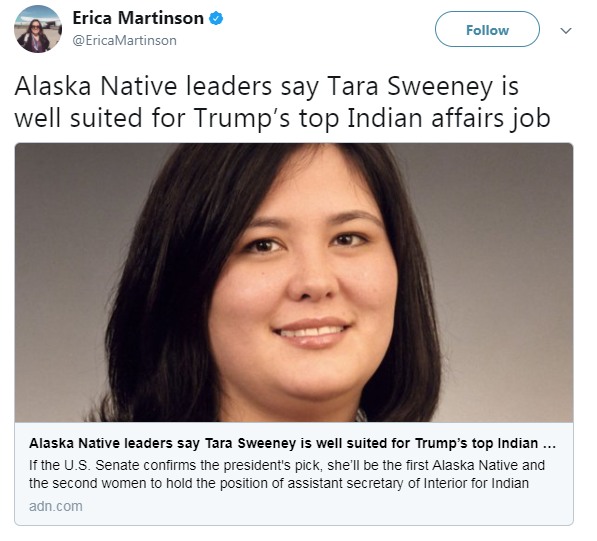
Alaska Dispatch News: Alaska Native leaders say Tara Sweeney is well suited for Trump’s top Indian affairs job. “Sweeney is tough and smart with the political savvy and instincts to negotiate bureaucracy, said Gloria O'Neill, who has long worked with Sweeney on boards and projects.”
KTUU-Alaska: Steady praise for the Alaskan chosen by President Trump for top Indian Affairs job. “Alaskan politicians commented on the nomination following the news, which was announced late Monday afternoon. The nomination was met with near-universal approval from the Alaskan lawmakers.”
Alaska Public Media: Applause sounds for Alaskan selected for Indian Affairs post at Interior. “Her nomination has Alaska’s U.S. senators literally cheering. Sen. Lisa Murkowski: ‘What a fabulous, fabulous nomination.’ Sen. Dan Sullivan: ‘Historic. Super-well qualified.’”
Indianz: National Congress of American Indians looks forward to Tara Sweeney confirmation. “The Assistant Secretary for Indian Affairs is charged with the federal responsibility to protect tribal sovereignty, treaty rights, and the trust relationship,” NCAI President Brian Cladoosby said on Tuesday. “This nomination is an important step by the administration, and we look forward a swift confirmation by the United States Senate...We appreciate the administration’s commitment to efficiently staffing important positions within governmental departments directly affecting Indian Country, and we look forward to hearing from Ms. Sweeney about her goals and plans for working with tribal leaders to ensure the government-to-government relationship is upheld.”
ELECTED OFFICIALS
Senator Lisa Murkowski said Sweeney has her full support: “Tara has a very strong record of professionalism and accomplishment in Alaska, across the country, and internationally, especially with the indigenous people of the circumpolar north. She has significant experience on Arctic issues and chaired the Arctic Economic Council. She is an expert on energy, infrastructure, broadband, economic development, Native self-determination, and a wide range of policy issues that will come before her. Secretary Zinke could not have chosen a better leader to help him fulfill the federal government’s trust responsibility, and I know Tara has the heart and drive to excel in this position.”
Congressman Don Young said Sweeney was an outstanding choice: “Tara’s knowledge, experience and leadership will go a long way in straightening out the BIA, allowing it to run more efficiently for the good of all First Americans. She has extensive experience not only in business, but also within Alaska Native groups and organizations. Tara knows first-hand the fight for Native empowerment and self-determination because she’s been on the front lines for years. There’s long been a problem with Native issues not receiving the priority they deserve but with Tara Sweeney at the helm, I have no doubt the Department of Interior will be paying close attention and the voices of our Native communities will be heard. Tara follows in great Alaskan footsteps, those of my dear friend Morris Thompson, and will do a fantastic job working on behalf of American Indians and Alaska Natives across the country.”
Sen. Dan Sullivan said it was a historic appointment for Alaskans: “I’ve worked with Tara Sweeney for years and I have witnessed first-hand her integrity, her strong leadership skills and her devotion to public service. Tara has a deep love for our state and people, and is relentless in her commitment to securing a better future for Alaska and the nation. With her long history of advocating for Alaska Native cultural values, rights, and economic opportunity, I can’t think of anyone better to have as our nation’s next Assistant Secretary for Indian Affairs.”
Governor Bill Walker praises the nomination of Tara Sweeney: "Tara's selection for this position is cause for celebration in Alaska. In each of my conversations with Secretary Zinke, I have encouraged him to include Alaskans for significant roles in his department. Tara's leadership in seeking self-determination and economic development for the people of the Arctic has been exemplary. As an Inupiaq tribal and corporate leader, she has sought the necessary balance between economic development and sustaining the ways of life and cultures of Alaska's First People. While many will be sad to see her leave ASRC, Tara's expertise will serve our state and nation well in this new role."
NATIVE LEADERS
Jackie Johnson Pata with the National Congress of American Indians: "I commend the Secretary for his choice of Tara Sweeney for the Position of Assistant Secretary. Tara's diverse experience in the areas of energy, natural resources, and tribal governance will be a welcome addition to the Department of Interior and NCAI looks forward to working with Tara in her new capacity."
John Berrey, Chairman of the Quapaw Tribe in Oklahoma.“Since March when he was sworn in, Secretary Zinke has been assembling a top-notch team of professionals to help him lead the Interior Department. With Tara Sweeney’s nomination, the Secretary is showing he means business when it comes to reforming the BIA and improving the delivery of services to Indian people. Tara’s long and dedicated service to the Alaska Federation of Natives, the Arctic Slope Regional Corporation and, most recently, the Arctic Economic Council, will be what is needed in the BIA’s top official. I thank the secretary for this nomination and pledge to help Tara achieve success for Native people any way I can.”
Leonard Smith, Executive Director of the Native American Development Corporation: “Ms. Sweeney’s background consists of the right elements to assist our economic development efforts with the tribes we serve in Montana, Wyoming, North and South Dakota towards economic sustainability. Her experience in energy, capital, government contracting and economic development give her the depth of knowledge to develop legislative solutions to federal policies that hinder economic development with tribal nations. We feel confident she will be able to promote stronger federal support through collaboration with other federal, state and private resources for implementation of the infrastructure necessary for economic growth and sustainability.”
Julie Kitka, President of the Alaska Federation of Natives: “In these critical times, Ms. Tara Sweeney will serve as a strong Assistant Secretary for Indian Affairs. Her experience with empowering Native Americans is unparalleled and she will help all tribes achieve great self-determination. There is not a Tribe or Alaska Native corporation that she would not help. I have had the opportunity to work alongside Ms. Sweeney for over a decade, I’ve seen her in action and she is driven by results.”
David Solomon, a Gwich’in activist from Fort Yukon: “'Oh it’s awesome! It’s good to see our Native leader be in the front line now. We’ve been recognized.' Solomon was in Washington, D.C. to rally opposition in the Senate to drilling in the Arctic National Wildlife Refuge. ASRC owns subsurface rights in the refuge and Sweeney has been a lead advocate in favor of drilling there. But Solomon takes a broader view and says Sweeney’s selection is “good for Alaska Natives.”
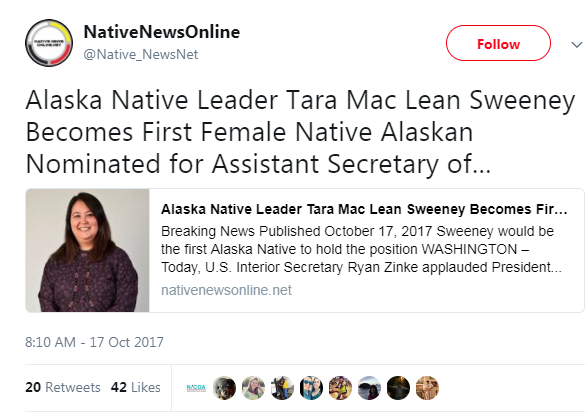
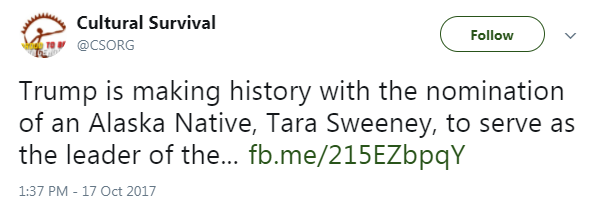
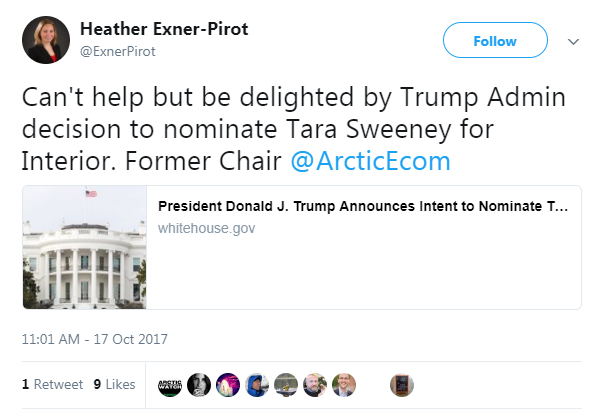
TWITTER RESPONSE
###
Indian Affairs - Office of Public Affairs
WASHINGTON, D.C. – Assistant Secretary – Indian Affairs Kevin K. Washburn today announced that, starting on December 14, 2012, the Bureau of Indian Affairs Office of Justice Services (OJS) will begin its “Don’t Shatter the Dream” campaign throughout Indian Country to prevent impaired driving during this holiday season. The campaign is being conducted by BIA and tribal law enforcement agencies through January 1, 2013.
“The ‘Don’t Shatter the Dream’ mobilization effort is a tremendous initiative that is conducted by the Bureau of Indian Affairs and tribal law enforcement agencies working together to keep drivers and passengers safe on Indian Country roads during the holiday season,” Washburn said. “I want to thank all of BIA and tribal law enforcement for their courageous service and efforts to promote and maintain traffic safety throughout Indian Country.”
The Don’t Shatter the Dream Indian State Impaired Driving Mobilization is a joint effort by the BIA’s Office of Justice Services (OJS), the Indian Affairs Indian Highway Safety Program (IHSP) and the U.S. Department of Transportation’s National Highway Traffic Safety Administration (NHTSA) to reduce injuries and save lives.
The campaign unites the BIA with tribal law enforcement agencies across the country to reinforce the message that driving while impaired will not be tolerated. Officers will be on alert throughout this holiday season conducting checkpoints and patrols to protect those travelling on reservation roadways.
This is the eighth year that the BIA has worked with tribal law enforcement personnel to set up enhanced enforcement on federal Indian lands in an effort to reduce motor vehicle crash injuries and fatalities, especially those attributed to impaired drivers.
Getting alcohol- and drug-impaired drivers off the road takes a great effort. More than 1.4 million Americans are arrested annually for driving under the influence of alcohol or drugs. Police arrest an average of 161 drunk drivers per hour alone.
According to the NHTSA’s Fatality Analysis in Reporting System (FARS), Native Americans are killed and injured at crash rates two to three times higher than the national average. The high rate of traffic fatalities is a concern across Indian Country. In 2009, a total of 440 Native Americans were killed in motor vehicle traffic crashes across the United States. Of those, 47 percent of the fatalities occurred in alcohol-impaired driving crashes with a driver’s blood alcohol content at or above the legal limit of intoxication – equaling a total of 207 fatalities.
“One life lost or severely damaged due to an impaired driving accident is too high a cost for any family or community to have to bear,” said OJS Deputy Bureau Director Darren Cruzan. “I encourage everyone to drive and ride safely this holiday season and throughout the new year.”
The BIA Office of Justice Services is responsible for managing the Bureau’s law enforcement, detention facilities and tribal courts programs, either directly in tribal communities or by funding tribally administered programs through contract and grants.
The IHSP, a part of the OJS, is charged with meeting the traffic safety needs of the 566 federally recognized tribes. One of its goals is to decrease alcohol-related motor vehicle crash injuries and fatalities in Indian Country. Visit https://www.bia.gov/bia/ojs for more information.
NHTSA’s mission is to save lives, prevent injuries and reduce economic costs due to road traffic crashes through education, research, safety standards, and enforcement activity. For more information, visit www.nhtsa.gov.
-DOI-
Indian Affairs - Office of Public Affairs
WASHINGTON, D.C. – Assistant Secretary – Indian Affairs Kevin K. Washburn visited the Pueblo of Isleta today to participate in the tribe’s impaired-driving checkpoint under the Bureau of Indian Affairs’ 2012 national campaign to prevent impaired driving during the holiday season, known as “Don’t Shatter the Dream.” Operated by the Bureau’s Office of Justice Services (OJS), the campaign began December 14 and will continue through January 1, 2013.
Washburn was joined by OJS Division of Highway Safety Deputy Associate Director Algin Young at the checkpoint, which was staffed by Isleta tribal police, where they watched officers check cars and deploy a Breath Alcohol Testing (BAT) Mobile unit provided by OJS to support the operation.
“The work done by Bureau of Indian Affairs and tribal law enforcement to serve and protect tribal communities like Isleta Pueblo is of vital interest to the administration and DOI,” Washburn said. “As a former assistant U.S. attorney in New Mexico, I am all too familiar with the human tragedies that result from impaired driving accidents. I want to thank our law enforcement officers and partners for this ‘Don’t Shatter the Dream’ mobilization, and urge everyone to drive and ride safely this holiday season.”
The BAT Mobile is a 40-foot long mobile unit that uses state-of-the art lighting, camera and communications systems. It has equipment to measure breath alcohol levels, a containment cell to transport suspects, and an interior camera to produce court-quality videos of the testing process.
“Keeping drivers and their passengers safe on the roadways during the holidays is the main goal of the Don’t Shatter the Dream’ mobilization,” Young said. “BIA and tribal police work together in an effort to reduce injuries and fatalities resulting from those driving under the influence of alcohol or drugs.”
The 211,095-acre Isleta Indian Reservation, located south of the city of Albuquerque, is home to a population of approximately 3,400 Isleta tribal members and other residents, and is traversed by 291 road miles. During their 2011 Don’t Shatter the Dream mobilization, Isleta tribal law enforcement issued numerous seat belt and speeding citations, and made five DUI arrests, with no fatalities occurring during the mobilization period.
This is the eighth year that BIA and tribal law enforcement officers have implemented the Don’t Shatter the Dream campaign on federal Indian lands.
The BIA Office of Justice Services’ mission is to enhance public safety and protect property in Indian Country by funding or providing law enforcement, corrections and tribal court services to the nation’s federally recognized tribes. It also coordinates emergency preparedness support on federal Indian lands by working cooperatively with other federal, state, local and tribal law enforcement agencies throughout Indian Country. It also operates the Indian Police Academy in Artesia, N.M., which provides training and professional development to BIA and tribal law enforcement personnel.
-DOI-
Indian Affairs - Office of Public Affairs
WASHINGTON – Assistant Secretary - Indian Affairs Tara Sweeney announced today that the Department of the Interior has signed agreements with the Oglala Sioux Tribe of the Pine Ridge Indian Reservation in South Dakota, the Northern Cheyenne Tribe of the Northern Cheyenne Indian Reservation in Montana, and the Santee Sioux Nation of the Santee Sioux Reservation in Nebraska to guide implementation of the Land Buy-Back Program for Tribal Nations at each of these reservations.
The Buy-Back Program implements the land consolidation component of the Cobell Settlement, which provided $1.9 billion to purchase fractional interests in trust or restricted land from willing sellers at fair market value within 10 years. Consolidated interests are immediately restored to tribal trust ownership for uses benefiting the reservation community and tribal members.
“Our partnerships with tribal nations recognize the importance of tribal sovereignty and support tailored implementation of the Buy-Back Program at each unique reservation,” said Assistant Secretary Sweeney. “Each tribe’s input and involvement is critical for outreach to landowners and overall effective implementation of the Program. Landowners and the Buy-Back Program benefit tremendously from the significant contributions of our tribal nation partners.”
To date, the Department has entered into agreements with 49 tribal nations to cooperatively implement the Buy-Back Program. The agreements outline coordinated strategies to facilitate education about the Program to landowners, but are unique in time, scope and responsibilities based on particular circumstances at each location.
These are the second agreements of their kind signed between the Department and the Oglala Sioux Tribe and the Northern Cheyenne Tribe.
“The Oglala Sioux Tribe is pleased to enter into an agreement with the Department,” said Oglala Sioux Tribe President Troy “Scott” Weston. “Through this agreement, we look forward to providing outreach to Tribal landowners regarding the Land Buy-Back Program. Our collaboration with the Department will enable landowners to voluntarily sell their fractionated trust land interests in order to benefit our Tribe.”
“This is the second time our Tribe will be involved in the purchase of fractionated trust land from individual Indian landowners. Consolidating our Tribal land base has been a priority for decades as it allows us to make better culturally-based resource management decisions, more opportunities to increase economic development and housing opportunities, strengthen Tribal sovereignty and most of all to preserve the sacredness of the land for the coming generations,” said Northern Cheyenne President L. Jace Killsback. “We value Secretary Zinke’s consideration and approval of our Tribe’s request for the Land Buy-Back to return to the Northern Cheyenne Reservation.”
This is the first agreement of its kind signed between the Department and the Santee Sioux Nation. “We are thankful for the opportunity to purchase from those members or stakeholders who wish to sell their interests in allotted lands to the Santee Sioux Nation,” said Chairman Roger Trudell. “It provides the Nation the opportunity to strengthen its Land holdings and we are grateful for this opportunity provided to us by the Land Buy-Back Program.”
Since the Program began making offers in December 2013, more than 765,000 interests and the equivalent of nearly 2.2 million acres of land have been transferred to tribal governments. As a result of the Buy-Back Program, tribal ownership now exceeds 50 percent in 14,700 more tracts of land (representing an increase of approximately 120 percent for the locations where implementation has occurred), strengthening tribal sovereignty and self-determination. Returning fractionated lands to tribes in trust has enormous potential to improve tribal community resources by increasing home site locations, improving transportation routes, spurring economic development, easing approval for infrastructure and community projects, and preserving traditional cultural or ceremonial sites.
Landowners can contact the Trust Beneficiary Call Center at 888-678-6836 or visit their local Office of the Special Trustee for American Indians to ask questions about their land or purchase offers. More information and detailed frequently asked questions are available at Buy Back Program FAQ to help individuals make informed decisions about their lands.
Indian Affairs - Office of Public Affairs
WASHINGTON, D.C.— The Bureau of Indian Education Family & Child Education Program (FACE) has received national recognition for its exceptional work in promoting young children’s heath and preventing childhood obesity. The recognition came from the first lady’s Let’s Move! Child Care initiative, Acting Assistant Secretary-Indian Affairs Del Laverdure announced today.
“Incorporating Let’s Move! activities into our own Let’s Move! in Indian Country is already having a positive impact on our students in BIE schools,” said Laverdure. “I am grateful to the first lady for initiating and leading the effort to reduce childhood obesity in Indian Country. Healthy students are key to Indian Country’s future.”
The Bureau’s FACE Program was recognized at the Let’s Move! Child Care Recognition Luncheon, which took place on May 9, 2012 at the Omni Shoreham Hotel in Washington, D.C. White House Assistant Chef and Senior Policy Advisor for Healthy Food Initiatives, Sam Kass, gave keynote remarks and highlighted FACE’s efforts.
The FACE program was recognized for carrying out exceptional work to promote and implement the goals of Let’s Move! Child Care. FACE includes using creative strategies, engaging families in obesity prevention efforts, and overcoming challenges to get children moving and encourage healthy eating in early care and education settings. FACE was one of twenty programs nationwide selected for recognition out of a multitude of groups including early education and child care programs and networks, communities, and states.
“It is extremely exciting and pleasurable to have been nominated and selected for this great honor and achievement,” said BIE Director Keith Moore. “The BIE is truly dedicated to being at the forefront of the movement to build a healthier and more sustainable future for our children across Indian Country. This award acknowledges our perseverance to achieve greatness, and inspires us to keep pushing forward.”
Let’s Move! Child Care is a nationwide call-to-action to empower early education and child care programs to make positive health changes in children that could last a lifetime. The initiative focuses on five goals:
- Physical Activity: Provide one-to-two hours of physical activity throughout the day, including outside play when possible.
- Screen Time: No screen time for children under two years. For children age two and older, strive to limit screen time to no more than 30 minutes per week during child care, and work with parents and caregivers to ensure children have no more than one-to-two hours of quality screen time per day, the amount recommended by the American Academy of Pediatrics.
- Food: Serve fruits or vegetables at every meal, eat meals family-style when possible, and no fried foods.
- Beverages: Provide access to water during meals and throughout the day, and do not serve sugary drinks. For children age two and older, serve low-fat (1%) or non-fat milk, and no more than one 4-6 ounce serving of 100% juice per day.
- Infant feeding: For mothers who want to continue breastfeeding, provide their milk to their infants and welcome them to breastfeed during the child care day; and support all new parents in their decisions about infant feeding.
Through Lets Move!, BIE’s FACE program emphasizes Body, Mind and Spirit. The 44 BIE FACE programs were able to collaborate with community resources, utilize Indian Health Services Physical Activity Kits in a Train-the-Trainers concept, increase Wellness programs, and add their own community twist to promoting healthy lifestyles. Humana joined forces with their partner organization, the National Center for Family Literacy, to donate pedometers, and tape measures, and create health journals for all adult students in the program.
Let’s Move! Child Care is supported by public and private partners, including the Office of the First Lady, the White House Domestic Policy Council, the Administration for Children and Families, the Centers for Disease Control and Prevention, the Health Resources and Services Administration, Nemours, Child Care Aware of America and the University of North Carolina. For more information about Let’s Move! Child Care, please visit: www.healthykidshealthyfuture.org
The 44 FACE Programs are located in 10 states in the U.S. funded by the Bureau of Indian Education. For more information about the FACE program contact Debbie Lente-Jojola, BIE Supervisory Education Specialist and FACE National Director, or please visit: http://www.bie.edu/Programs/FACE/index.htm.
The Let’s Move in Indian Country website http://www.letsmove.gov/indiancountry includes information about resources, grants and programs available to assist schools in becoming healthier places of learning.
The Bureau of Indian Education in the U.S. Department of the Interior implements federal education laws, such as the No Child Left Behind Act, in and provides funding to 183 elementary and secondary day and boarding schools and peripheral dormitories located on 64 reservations in 23 states and serving approximately 48,000 students from the nation’s federally recognized tribes. Approximately two-thirds are tribally operated with the rest BIE-operated. The bureau also serves post secondary students through higher education scholarships and support funding to 26 tribal colleges and universities and two tribal technical colleges. It also directly operates two post secondary institutions: Haskell Indian Nations University in Lawrence, Kan., and the Southwestern Indian Polytechnic Institute in Albuquerque, N.M.

indianaffairs.gov
An official website of the U.S. Department of the Interior
Looking for U.S. government information and services?
Visit USA.gov