


<p>Office of Public Affairs</p>
Official websites use .gov
A .gov website belongs to an official government organization in the United States.
Secure .gov websites use HTTPS
A lock
()
or https:// means you’ve safely connected to the .gov website. Share sensitive information only on official, secure websites.
OPA
 Indian Affairs - Office of Public Affairs
FARGO – A number of concerns have recently been raised about public safety and criminal investigations on the Fort Berthold Reservation. In response to these concerns, Christopher Myers, the U.S. Attorney for the District of North Dakota, and Charles Addington, the Director of the Office of Justice Services at the Bureau of Indian Affairs, met in Fargo earlier this month to discuss law enforcement resources and jurisdictional issues on the Fort Berthold Reservation. As a result of this meeting, the BIA is taking steps to enhance investigative resources and will soon increase its staffing levels from one to two investigators.
Both the BIA and Department of Justice are committed to doing their part to improve public safety and conduct effective criminal investigations on the Fort Berthold Reservation. This includes helping to drive down the high rate of violence against women and children and assisting in the active and ongoing investigation into a suspicious death case. However, the BIA and DOJ also recognize the necessary and vital role that tribal law enforcement must play in this process. To that end, the BIA is in communication with tribal law enforcement about how to improve the effectiveness of investigations on the Fort Berthold Reservation. In addition, DOJ is working with the FBI and the Department of the Interior to ensure the prompt provision of investigative resources for serious crimes such as domestic and sexual violence against women and children prevalent on North Dakota reservations.
The Departments of Justice and Interior are working together to deliver training to improve the quality of investigations and coordination among law enforcement agencies and jurisdictions in Indian Country. To provide quality training techniques to law enforcement responsible for conducting criminal investigations in Indian Country, the BIA and FBI have teamed up and developed a nine-day Indian Country Criminal Investigator Training Program. The training program is highly interactive and filled with hands-on labs specific to conducting criminal investigations in Indian Country. In addition, the Department of Justice is identifying training resources that can be brought to the field to improve the capacity of tribal and federal law enforcement to address the situation.
####
Indian Affairs - Office of Public Affairs
WASHINGTON – In keeping with President Obama’s commitment to tribal self-governance and strengthening tribal economies, acting Assistant Secretary – Indian Affairs Lawrence S. Roberts today announced that Ohkay Owingeh now has the sovereign authority to lease tribal lands consistent with the Helping Expedite and Advance Responsible Tribal Homeownership (or HEARTH) Act. Roberts was joined by Ohkay Owingeh Governor Earl N. Salazar and United States Senator Martin Heinrich at a signing ceremony approving the tribe’s leasing regulations that took place yesterday at the Pueblo in New Mexico.
“I congratulate Governor Salazar and the Ohkay Owingeh council for their leadership in using the HEARTH Act to end the paternalistic policy of federal approval of tribal leasing decisions,” acting Assistant Secretary Roberts said. “Ohkay Owingeh joins a growing number of tribes that are exercising sovereignty over the leasing of their lands to promote the health, welfare and prosperity of their people. By this action, decision making over the use of tribal land is now squarely in the hands of the tribal government. I am very pleased that Ohkay Owingeh has exercised this power to use its own judgment for its own lands.”
“We are now able to establish and carry out these laws. As an entrepreneurial tribe, we look forward to working with local businesses,” Governor Salazar said. “It all comes back to sovereignty and, finally, we have control over our land to help support our people.”
"I’m honored to join the people of Ohkay Owingeh to mark this milestone in strengthening self-determination and tribal sovereignty, and open doors to more jobs and economic development in Indian Country,” Senator Heinrich said. “The last thing the federal government should do is stand in the way of a family who wants to buy a home. This agreement through the HEARTH Act will make it easier for Native families to buy houses and open businesses in the communities where their families have lived for generations.”
The acting Assistant Secretary’s action confirms that federal approval is no longer necessary for Ohkay Owingeh, a federally recognized tribe in north central New Mexico, to enter into surface land leases. The Pueblo will exercise authority over leases for agricultural, business, cultural, educational, residential, wind and solar power, and other authorized purposes.
The HEARTH Act creates a voluntary, alternative land leasing process available to federally recognized tribes once their governing leasing regulations have been approved by the Secretary of the Interior. Tribes with approved regulations are authorized to negotiate and enter into surface leases without further approvals by the Secretary. The Act authorizes tribes to execute agricultural and business leases of tribal trust lands for a primary term of 25 years and up to two renewal terms of 25 years each. Leases of tribal trust lands for residential, recreational, religious or educational purposes may be executed for a primary term of up to 75 years.
The HEARTH Act eliminates the paternalistic approval process codified in federal law and recognizes the authority of federally recognized tribes to develop and implement their own laws governing the long-term leasing of their trust lands for residential, business, renewable energy, and other purposes. Tribes that use the HEARTH Act procedure eliminate the Bureau of Indian Affairs (BIA) approval process for surface land leases, thereby greatly expediting tribal leasing for homes, businesses and other purposes in Indian Country.
The principles supporting the federal preemption of state law in the field of Indian leasing and the taxation of lease-related interests and activities apply with equal force to leases issued by tribes that have utilized the HEARTH Act.
In accordance with federal law and the Department’s regulations governing the surface leasing of trust and restricted Indian lands, tribal leases are subject to tribal, not state and local, taxation.
The HEARTH Act was intended to promote tribal sovereignty by empowering tribal governments to adapt lease terms that suit their business and cultural needs and to promote approval of leases quickly and efficiently. Therefore, the assessment of state and local taxes would obstruct the federal policies of supporting tribal economic development and self-determination. Such taxation would also threaten tribal interests in effective tribal government, economic self-sufficiency and territorial autonomy.
With the acting Assistant Secretary’s action today, 23 federally recognized tribes now have utilized the HEARTH Act:
- Federated Indians of Graton Rancheria, Calif. (Business)
- Pueblo of Sandia, N.M. (Business)
- Pokagon Band of Potawatomi Indians, Mich. (Residential)
- Ak-Chin Indian Community, Ariz. (Business)
- Santa Rosa Band of Cahuilla Indians, Calif. (Business)
- Citizen Potawatomi Nation, Okla. (Business)
- Ewiiaapaayp Band of Kumeyaay Indians, Calif. (Business)
- Kaw Nation, Okla. (Business)
- Jamestown S’Klallam Tribe, Washington State (Business)
- Dry Creek Rancheria Band of Pomo Indians, Calif. (Business)
- Wichita and Affiliated Tribes, Okla. (Business)
- Mohegan Tribe of Indians of Connecticut (Business)
- Agua Caliente Band of Cahuilla Indians, Calif. (Business)
- Seminole Tribe of Florida (Individual Business and Residential Ordinances)
- Cowlitz Indian Tribe, Washington State (Business)
- Oneida Indian Nation, N.Y. (Business)
- Ho-Chunk Nation of Wisconsin (Business, Residential and Agricultural Codes)
- Absentee-Shawnee Tribe of Indians of Oklahoma (Business)
- Rincon Band of Luiseno Mission Indians, Calif. (Business)
- Makah Indian Tribe, Wash. (Residential, Business, Renewable Energy)
- Squaxin Island Tribe, Wash. (Business)
- Gila River Indian Community, Ariz. (Business and Solar)
Under the leadership of Senator Heinrich, Congress passed the HEARTH Act with overwhelming bipartisan support. It was signed by President Obama on July 30, 2012.
The Assistant Secretary – Indian Affairs oversees the BIA, which is headed by a director who is responsible for managing day-to-day operations through four offices – Indian Services, Justice Services, Trust Services, and Field Operations. These offices directly administer or fund tribally based infrastructure, law enforcement, social services, tribal governance, natural and energy resources, and trust land and resources management programs for the nation’s federally recognized American Indian and Alaska Native tribes through 12 regional offices and 81 agencies. The BIA’s Office of Trust Services administers the HEARTH Act leasing approval process.
Indian Affairs - Office of Public Affairs
WASHINGTON, D.C. — On Thursday, Jan. 31., 2013, the Department of the Interior will hold the first of three tribal consultation sessions on its Initial Implementation Plan outlining how Interior will carry out the land consolidation component of the historic Cobell Settlement. The first meeting will take place in Prior Lake, Minn., with the remaining sessions to be held Feb. 6 in Rapid City, S.D., and Feb. 14 in Seattle, Wash.
“The Land Buy-Back Program is a historic opportunity to address the fractionation problem and restore lands to Indian tribes, but it will not succeed without the active support of tribal leaders,” said Assistant Secretary – Indian Affairs Kevin K. Washburn. “The Department is keenly interested in receiving guidance from tribal leaders on the draft Plan.”
The Settlement provided a $1.9 billion fund to purchase fractional interests in American Indian trust lands from willing sellers, thereby enabling federally recognized tribal governments to use the consolidated parcels for the benefit of their communities. The Plan reflects comments received from tribal consultation sessions the Department held in the summer and fall of 2011 and on a draft Plan released in January 2012. On Dec. 18, the Department announced the launch of the Land Buy-Back Program for Tribal Nations, which will purchase the fractional interests, as well as a Secretarial Order outlining the program’s organizational structure.
For more information about the Land Buy-Back Program for Tribal Nations, the Cobell land consolidation component, the Initial Implementation Plan, and the Department’s 2011 and 2013 tribal consultation sessions, visit www.doi.gov/buybackprogram.
|
WHO |
Michele Singer, Deputy Special Trustee, Office of the Special Trustee for American Indians, DOI John McClanahan, Program Manager, Land Buy-Back Program for Tribal Nations, DOI Anthony N. Walters, Counselor to the Deputy Assistant Secretary – Indian Affairs, DOI Darryl LaCounte, Senior Advisor to the Director, Bureau of Indian Affairs, DOI |
|
WHAT |
First tribal consultation session on the Department’s Initial Implementation Plan for the Cobell Settlement land consolidation component. |
|
WHEN |
Thursday, January 31, 2013 9:00 a.m. – 4:00 p.m. (local time) |
|
WHERE |
Mystic Lake Casino and Hotel, 2400 Mystic Lake Blvd., Prior Lake, Minn. 55372; Phone: 952-445-9000. |
CREDENTIALS: All media must present government-issued photo I.D. (such as a driver’s license) and valid media credentials.
-DOI-
Indian Affairs - Office of Public Affairs
WASHINGTON – Assistant Secretary – Indian Affairs Kevin K. Washburn will speak on Tuesday, June 25 at the opening of the National Congress of American Indians’ 2013 Mid-Year Conference in Reno, Nev. The National Congress of American Indians is the oldest and largest association of tribal governments in the United States. The Assistant Secretary will update tribal leaders on a number of Interior Department activities in Indian Country including:
• Steps taken to-date to implement the Department’s Land Buy-Back Program for Tribal Nations that will purchase from willing sellers their fractional interests in American Indian trust lands to benefit federally recognized tribes;
• Proposed changes to Bureau of Indian Affairs land-into-trust regulations in response to last year’s United States Supreme Court decision in Match-E-Be-Nash-She-Wish Band of Pottawatomi Indians v. Patchak;
• The Department’s new regulations implementing the Buy Indian Act; and • Development of a discussion draft on changes to Interior’s federal acknowledgement regulations.
|
WHO: |
Kevin K. Washburn, Assistant Secretary – Indian Affairs, DOI |
|
WHAT: |
Assistant Secretary Washburn will speak at the National Congress of American Indians’ 2013 Mid-Year Conference. |
|
WHEN: |
Tuesday, June 25, 2013, 11:20 a.m. (PDT) |
|
WHERE: |
Atlantis Casino Resort and Spa, Grand Ballroom, 3800 S. Virginia St., Reno, Nev. 89502. Phone: 775-825-4700 |
CREDENTIALS: This invitation is extended to credentialed media representatives, who must display sanctioned media credentials for admittance to the event.
-DOI-
Indian Affairs - Office of Public Affairs
WASHINGTON, D.C. – The Department of the Interior today announced the launch of a new, comprehensive resource for Indian landowners and tribal governments seeking information about the Land Buy-Back Program for Tribal Nations (Buy-Back Program). The website, http://www.doi.gov/buybackprogram, will serve as a one-stop-shop for visitors interested in timely and regularly updated information about the Buy-Back Program.
As part of President Obama’s commitment to help strengthen Indian communities, the Buy-Back Program was created to implement the land consolidation component of the Cobell Settlement, which provided a $1.9 billion fund to purchase fractionated interests in trust or restricted land from willing sellers, at fair market value, within a 10 year period. The Buy-Back Program has the potential to unlock millions of acres of fractionated lands for the benefit of tribal communities.
“We know that one of the keys to the success of this program will be timely and reliable information,” said Kevin Washburn, Assistant Secretary for Indian Affairs at Interior. “This website will be one important tool that we will use to communicate with tribes as we work collaboratively to implement a fair, effective and efficient process for individual owners of fractionated interests to participate in the Buy-Back Program."
The new website includes extensive “Frequently Asked Questions” and information to assist individual landowners and tribes in gathering information about how they can participate in the Buy-Back Program and understand the valuation and sale process. Visitors can also get information about the Education Scholarship Fund for American Indians and Alaska Natives. The Buy-Back Program will contribute up to $60 million from land sales to this fund, which will be controlled by a board of trustees nominated by tribal governments. The fund will be administered by the American Indian College Fund in Denver, with 20% allotted to the American Indian Graduate Center in Albuquerque, NM.
As part of today’s launch, the Buy-Back Program is making available templates and guidance for the development of cooperative agreements that will allow for resources to be provided to individual tribal governments in order to facilitate their help with implementing the program, especially in key areas such as landowner outreach and education. Although these agreements will be tailored for each tribe, the templates will assist tribal governments with the development of an agreement that is responsive to the specific needs of the nation involved. Tribes may review and familiarize themselves with these documents and are encouraged to contact Buy-Back staff to discuss the documents before preparing or submitting an application.
“We have already begun work with a diverse group of tribes and will be engaging with additional locations and tribes in the coming weeks and months,” added Washburn. “To ensure that the Buy-Back Program reaches as many locations as possible over the next 10 years, we are committed to using the funds wisely and have implemented flexible purchase ceilings on each reservation to avoid premature exhaustion of available funds.”
The publication of these and other documents to assist tribal governments with outreach comes after months of government-to-government consultations and discussions with tribes to create agreements that underscore the sovereign and trust responsibilities of each party.
Interior holds about 56 million acres in trust for American Indians. More than 10 million acres are held for individual American Indians and nearly 46 million acres are held for Indian tribes. The Department holds this land in more than 200,000 tracts, of which about 92,000 (on approximately 150 reservations) contain fractional ownership interests subject to purchase by the Buy-Back Program. The Buy-Back Program plans to work with as many of the 150 tribes as possible over its 10-year period. Land research, valuation work, and outreach efforts are already underway at several locations. The Department’s goal is to make offers at one or more initial locations by the end of the year.
Indian Affairs - Office of Public Affairs
ASHEVILLE, N.C. – A major law enforcement operation targeting drug trafficking in and around Indian Country in North Carolina has resulted in the arrest of more than 75 individuals on federal, state and tribal charges, announced U.S. Secretary of Interior Ryan Zinke and Andrew Murray, U.S. Attorney for the Western District of North Carolina. Additionally, the months-long operation yielded more than 248 pounds of illegal substances including heroin, methamphetamine, and hundreds of opioid pills with an estimated street value of $2 million. Officers also seized 6 illegally-possessed firearms. This operation is the latest conducted by the Interior Department’s task force which Secretary Zinke formed in March 2018 to target the opioid crisis in Indian Country.
The undercover operation, led by the Department of Interior’s Opioid Reduction Task Force, in coordination with the Drug Enforcement Administration (DEA), the Eastern Band of Cherokee Indian Police Department and multiple federal, state, and local law enforcement agencies, began in March 2018, and aimed at disrupting and dismantling drug distribution networks operating in and around the Qualla Boundary.
“First and foremost, bravo zulu to the dozens of law enforcement professionals who are on the front lines and putting their own lives at risk to take these deadly drugs off the streets. President Trump and I could not be prouder of their work,” said Secretary Zinke. “It’s heartbreaking to see the scale of the problem, and rather than further stigmatizing victims, we are cracking down on the dealers who are selling out our children, selling out our communities, and selling out our nation. The Trump Administration is serious about ending the opioid crisis and that means both treatment of those suffering as well as eradicating the drugs from our communities. This week’s law enforcement action gets us closer to that goal.”
“I am extremely grateful to the Secretary of the Interior, the BIA and the multiple state and local agencies who helped make this operation a success," said Principal Chief of the Eastern Band of Cherokee Richard Sneed. "The arrest of these drug dealers is a critical step towards ensuring that the Eastern Band of Cherokee Indians are able to provide the healthy environment our people deserve.”
In addition to the 75 arrests announced today in connection with DOI’s Opioid Reduction Task Force operation, a concurrent two-year investigation spearheaded by the Bureau of Indian Affairs’ Division of Drug Enforcement and the DEA led to the previous arrest of 57 additional individuals responsible for trafficking opiates and methamphetamine in Indian Country, bringing the total number of those arrested as part of the Western District’s drug reduction initiative on the Cherokee Indian Reservation to 132.
To date, the joint investigations have also yielded a seizure of more than 5 pounds of heroin and Fentanyl; more than 20 pounds of methamphetamine; over 210 Fentanyl tablets and Oxycodone tablets; and more than 223 pounds of marijuana, with a combined street value of over $2 million. Over the course of the investigation, law enforcement also seized six illegally possessed firearms.
Other partners involved in the operation include: the DEA; the Eastern Band of Cherokee Indian Police Department; the Swain County Sheriff’s Office; the Jackson County Sheriff’s Office; the McDowell County Sheriff’s Office; the Henderson County Sheriff’s Office; the Rutherford County Sheriff’s Office; Buncombe County Sheriff’s Office; the Asheville Police Department; the North Carolina State Bureau of Investigation; and the North Carolina State Highway Patrol; and the U.S. Marshals Service for their coordinated efforts throughout this investigation.
Last year, Attorney General Jeff Sessions announced a series of new actions by the Justice Department to support law enforcement and maintain public safety in Indian Country. Among the actions announced, was the deployment of the expanded Tribal Access Program for National Crime Information (TAP), which is designed to provide the Eastern Band of Cherokee Indians, and other federally-recognized tribes, access to national crime information databases for criminal and civil purposes. TAP allows tribes to more effectively serve and protect their nations’ citizens by ensuring the exchange of critical data across the Criminal Justice Information Services (CJIS) systems and other national crime information systems.
In addition, the Office of Tribal Justice created the Indian Country Federal Law Enforcement Coordination Group, an unprecedented partnership that brings together sworn federal agents and key stakeholders from 12 federal law enforcement components with responsibilities in Indian Country, with the goal of increasing collaboration and coordination among law enforcement and enhancing the response to violent crime in Indian Country.
###
Indian Affairs - Office of Public Affairs
WASHINGTON – Assistant Secretary – Indian Affairs Kevin K. Washburn today announced the Bureau of Indian Education’s (BIE) intent to establish a Committee to help evaluate and recommend revisions to regulations for determining Adequate Yearly Progress (AYP) for its schools under the No Child Left Behind Act. The BIE is also seeking comments on the proposal to establish this Committee and nominations for its membership by March 4, 2013.
“The changing landscape with respect to state accountability standards under the No Child Left Behind Act means the Bureau of Indian Education must also change its approach to determining Adequate Yearly Progress for its schools,” Washburn said. “The BIE must have the ability to produce measurable data on student academic achievement, and I strongly encourage tribal leaders to submit nominations for this AYP Negotiated Rulemaking Committee.”
The No Child Left Behind Act amended the Elementary and Secondary Education Act, in part, to require the Bureau of Indian Affairs (BIA) to promulgate regulations for a student progress accountability system, which includes a specific methodology for calculating AYP, to be used in Bureau-funded schools. In 2005, the BIA promulgated regulations that require the BIE to use the accountability system of the state where a Bureau-funded school is located in order to calculate the school’s AYP.
With schools in 23 states, each state having its own accountability system, the BIE developed a method for comparing academic achievement across states despite the variance in academic standards. However, the U.S. Department of Education has granted some states flexibility waivers from the requirements of the No Child Left Behind Act. These waivers have increased the degree of difficulty challenging the BIE in using 23 state accountability systems to effectively compare achievement among its schools. Therefore, the Secretary, through authority delegated to the Assistant Secretary – Indian Affairs, has determined that a new rule is needed.
The Secretary also is seeking nominations for tribal representatives to serve on the Committee, especially those who have a demonstrated ability to communicate well with groups about the interests they will represent. The Committee cannot exceed 25 members. Nominations for tribal representatives and alternates are being solicited from tribes whose students attend Bureau-funded schools operated either by the BIE or the tribe through a contract or grant.
Nominations for Committee members or written comments on the proposal to establish an AYP Negotiated Rulemaking Committee may be submitted by close of business on March 4, 2013, to Sue Bement, Designated Federal Officer, Bureau of Indian Education, 1011 Indian School Rd., N.W., Suite 332, Albuquerque, N.M. 87104, Phone: 505-563-5274, Fax: 505-563-5281; by email to AYPcomments@bia.gov; or hand-delivered to the BIE at the Manuel Lujan Jr. Building, Building II, Suite 332, 1011 Indian School Rd., N.W., Albuquerque, N.M. 87104.
For more information on the proposed AYP Negotiated Rulemaking Committee, including criteria and submission instructions for nominees and negotiated rulemaking procedures, see the Federal Register notice at http://www.gpo.gov/fdsys/pkg/FR-2013-01-31/pdf/2013-01957.pdf.
The Assistant Secretary – Indian Affairs oversees the Bureau of Indian Education, which operates the federal school system for American Indian and Alaska Native children from the federally recognized tribes. The BIE provides funding and implements federal education laws, such as the No Child Left Behind Act, for 183 elementary and secondary day and boarding schools and peripheral dormitories on 64 reservations in 23 states that serve about 42,000 students. The BIE also serves post secondary students through higher education scholarships and administers operating grants to 26 tribal colleges and universities and two tribal technical colleges. It also directly operates two post secondary institutions: Haskell Indian Nations University in Lawrence, Kan., and the Southwestern Indian Polytechnic Institute in Albuquerque.
-DOI-
Indian Affairs - Office of Public Affairs
WASHINGTON — On Thursday, Feb. 14, 2013, the Department of the Interior will hold the third and last in a series of consultation sessions on its Initial Implementation Plan outlining how Interior will carry out the land consolidation component of the historic Cobell Settlement. The meeting will take place in Seattle, Wash. The first and second consultation meetings were held Jan. 31 in Prior Lake, Minn., and Feb. 6 in Rapid City, S.D.
“The Land Buy-Back Program is a historic opportunity to address the fractionation problem and restore lands to Indian tribes, but it will not succeed without the active support of tribal leaders,” said Assistant Secretary – Indian Affairs Kevin K. Washburn. “The Department is keenly interested in receiving guidance from tribal leaders on the draft Plan.”
The Settlement provided a $1.9 billion fund to purchase fractional interests in American Indian trust lands from willing sellers, thereby enabling federally recognized tribal governments to use the consolidated parcels for the benefit of their communities. The Plan reflects comments received from tribal consultation sessions the Department held in the summer and fall of 2011 and on a draft Plan released in January 2012. On Dec. 18, the Department announced the launch of the Land Buy-Back Program for Tribal Nations, which will purchase the fractional interests, as well as a Secretarial Order outlining the program’s organizational structure.
For more information about the Land Buy-Back Program for Tribal Nations, the Cobell land consolidation component, the Initial Implementation Plan, and the Department’s 2011 and 2013 tribal consultation sessions, visit www.doi.gov/buybackprogram/index.cfm.
|
WHO |
Michele Singer, Deputy Special Trustee, Office of the Special Trustee for American Indians, DOI John McClanahan, Program Manager, Land Buy-Back Program for Tribal Nations, DOI Anthony N. Walters, Counselor to the Deputy Assistant Secretary – Indian Affairs, DOI Michael S. Black, Director, Bureau of Indian Affairs, DOI |
|
WHAT |
Third and last tribal consultation session on the Department’s Initial Implementation Plan for the Cobell Settlement land consolidation component. |
|
WHEN |
Thursday, February 14, 2013, 9:00 a.m. – 4:00 p.m. (local time) |
|
WHERE |
The Arctic Club Seattle – a DoubleTree by Hilton Hotel, 700 3rd Ave., Seattle, Wash. 98104; Phone: 206-340-0340 |
CREDENTIALS: All media must present government-issued photo I.D. (such as a driver’s license) and valid media credentials.
-DOI-
Indian Affairs - Office of Public Affairs
FORT TOTTEN, N.D. – Deputy Assistant Secretary – Indian Affairs Lawrence S. Roberts reported personally to Spirit Lake tribal members today on efforts the Bureau of Indian Affairs (BIA) has taken to-date to address child safety and protection issues on the Spirit Lake Reservation in North Dakota. Roberts represented Assistant Secretary – Indian Affairs Kevin K. Washburn, whose testimony at a congressional hearing also taking place today precluded his attendance at the community event.
“Addressing child safety and protection issues at Spirit Lake is a top priority for the Bureau of Indian Affairs, as I know it is for this entire community,” Roberts said. “We have dedicated staff and resources to work on this issue and we will continue to work with the tribe, our federal partners, and all the stakeholders to improve and strengthen child safety. Assistant Secretary Washburn and I are committed to reducing violent crime, sexual assault and domestic violence in Indian Country. Here in Spirit Lake, as elsewhere in Indian Country, protecting children must be our highest priority.”
The deputy assistant secretary was joined by Timothy Q. Purdon, U.S. Attorney for the District of North Dakota; Marilyn Kennerson, Administration for Children and Families Regional Program Manager for Child Welfare, U.S. Department of Health and Human Services; BIA officials Sue Settles, chief of the Division of Social Services; Darren Cruzan, deputy bureau director of the Office of Justice Services; Weldon Loudermilk Great Plains regional director; Roderick Cavanaugh, Fort Totten Agency superintendent; and bureau regional and agency staff.
Roberts reported on actions BIA has taken since the Spirit Lake Sioux Tribe retroceded its 638- contracted social services program to the BIA on October 1, 2012.
Since October 1, the BIA has established a new social services office at the Fort Totten Agency while simultaneously working to provide critical services to Spirit Lake children and families.
Roberts Updates Spirit Lake Community
The BIA has served the Spirit Lake community by:
- Providing child protection, child welfare assistance, case management, emergency assistance, burial assistance, and family and community services, as well as supervising Individual Indian Money (IIM) accounts; • Receiving, reviewing and investigating over 300 reports of alleged child abuse and/or neglect;
- Maintaining and managing current and active case files for 129 children, as well as coordinating services for children and families, making referrals, conducting permanency planning, and supervising visits;
- Ensuring staff is on call after hours and on weekends;
- Participating on Child Protection and Multi-disciplinary Teams and hosting team meetings to review on a regular basis child abuse and neglect cases;
- Working with BIA law enforcement and other federal, tribal, state and local child safety and protection providers;
- Utilizing mobile fingerprinting devices for in-home fingerprinting of adults in foster homes where children in protected care may be placed, as well as monitoring and tracking those individuals; and
- Hiring two additional in-house social services personnel and working to recruit and hire four more.
The level of resources provided by the BIA to Spirit Lake includes rotating nineteen social workers from other BIA agencies to the Fort Totten Agency at various intervals since October 1 to provide support and expertise during the tribal program’s transition to Bureau management. Roberts also reported on the BIA Office of Justice Services’ (BIA OJS) work with the Fort Totten Agency and federal law enforcement on child safety and protection at Spirit Lake:
- Training Agency social services staff in the use of mobile fingerprinting units and assisting with the fingerprinting of foster parents.
- Investigating allegations of child abuse and neglect at Spirit Lake.
- Continuing to work with the Federal Bureau of Investigation and the U.S. Attorney’s Office in North Dakota on all active Spirit Lake cases.
- Holding tribal court tribal advocacy training on June 18-20 in Grand Forks, N.D., for tribal judges, public defenders and prosecutors on cases dealing with sexual assault on children.
Under the leadership of Attorney General Eric Holder, the U.S. Department of Justice launched a Department-wide initiative in 2009 to enhance public safety in Indian County. The U.S. Attorney’s Office in North Dakota has made substantial progress in implementing that strategy.
“The North Dakota U.S. Attorney’s Office continues to work closely with the FBI and BIA law enforcement to investigate and prosecute crimes that arise on the Spirit Lake Reservation,” Roberts Updates Spirit Lake Community Purdon said. “Allegations of crimes committed against children are a priority for us and we will continue to work hard to protect and seek justice for those young victims who are the most vulnerable among us. Residents of the Spirit Lake Reservation can assist the Department of Justice in our efforts by reporting any and all crimes to law enforcement.”
Purdon also discussed the implementation of his office’s Anti-Violence Strategy for Tribal Communities in North Dakota and its work toward improving public safety at Spirit Lake and across Indian Country in North Dakota. These efforts include:
- Pediatrician-led training in October 2011 on the Spirit Lake Reservation organized by the U.S. Attorney’s Office for the District of North Dakota (USAOND) for tribal first responders on recognizing the signs of head trauma, sexual abuse, neglect, and physical abuse on children;
- Training sessions organized by USAOND and the United States Marshal’s Service on the implementation of the Sex Offender Registration and Notification Act (SORNA) to law enforcement and tribal court professionals from Spirit Lake;
- Conducting monthly Multi-disciplinary Team meetings on the Spirit Lake Reservation which are led by USAOND’s Tribal Liaison and which bring together FBI and BIA law enforcement, child protective services, tribal prosecutors, and others to address issues facing child victims of violence at Spirit Lake;
- Hosting the USAOND’s annual Tribal Consultation Conference in Bismarck, N.D., to discuss with all of the tribes in North Dakota successful strategies for improving public safety on the reservations; and
- An increase of over 80 percent in the number of federal Indian country criminal cases brought by the USAOND from fiscal year 2009 to fiscal year 2012.
Roberts also announced that the Fort Totten Agency is partnering with various tribal and county programs to hold a child and family wellness fair next month, to promote and increase community awareness about resources and services available to children and families, and a sexual abuse awareness event in April.
“It’s been said that it takes a village to care for a child, and that has certainly been the case at Spirit Lake,” Roberts said. “There is a tremendous level of concern for Spirit Lake’s children and families that is being demonstrated every day by our dedicated law enforcement and social service professionals, our federal, state and local partners, and the Spirit Lake tribal leadership. As we continue our nation-to-nation work with the Spirit Lake Tribe on this matter, we commend the Tribe for the assistance they provide our staff to protect Spirit Lake’s children.”
-DOI-
Indian Affairs - Office of Public Affairs
WASHINGTON – Assistant Secretary – Indian Affairs Tara Mac Lean Sweeney today signed a memorandum of understanding (MOU) with the U.S. Department of Commerce and the American Indian Alaska Native Tourism Association (AIANTA) to formalize that group’s role in strengthening collaboration and coordination related to travel and tourism on federal and tribal lands, in accordance with Public Law 114-221, the Native American Tourism Improving Visitor Experience Act, or NATIVE Act, of 2016.
The signing took place during AIANTA’s 20th anniversary conference in Albuquerque, N.M., where Assistant Secretary Sweeney spoke at the event’s morning session.
“I congratulate AIANTA on its 20th anniversary of helping bring the benefits of tourism to Indian Country,” Sweeney said. “This MOU enters the Departments of Interior and Commerce and their respective bureaus and agencies into a collaborative partnership with AIANTA for the implementation of the NATIVE Act. I am honored to be here today, and pleased to sign this agreement creating a new partnership between AIANTA, Interior and Commerce whose goal is to develop and strengthen tourism’s important role in sustaining tribally based economies.”
“We are delighted to be working with the Department of the Interior and the Department of Commerce to formalize our long-standing relationships and strengthens our ability to enhance and grow tribal tourism,” said AIANTA Executive Director Camille Ferguson. “The signing of this Memorandum of Understanding opens the door and removes barriers for future collaborations and outreach to tribes.”
“The Department of Commerce remains committed to the economic development of Native American communities,” said Department of Commerce Assistant Secretary for Legislative and Intergovernmental Affairs Michael Platt. “As more Americans and overseas travelers spend time in these communities, they will experience firsthand the wonder of landscapes and natural beauty, as well as learn about the rich heritage, history and cultures of Native Americans.”
AIANTA is a nonprofit association of American Indian and Alaska Native tribes, Native Hawaiian organizations and tribal businesses dedicated to advancing Indian Country and Native Hawaiian tourism. It is a voice and resource for these communities who are, or seek to become, engaged in cultural tourism. It helps members develop, sustain and grow tourism destinations, in a manner that respects and honors Native traditions and values, through technical assistance as well as training and educational resources.
Congress enacted the NATIVE Act to enhance and integrate Native American tourism, empower Native American communities, increase coordination and collaboration between federal tourism assets, and expand heritage and cultural tourism opportunities in the United States. The purposes of the NATIVE Act are to:
- Enhance and integrate Native American tourism, empower Native American communities, and advance the National Tourism Strategy;
- Increase coordination and collaboration between federal tourism assets to support Native American tourism and bolster recreational travel and tourism;
- Expand heritage and cultural tourism opportunities in the United States to spur economic development, create jobs and increase tourism revenues;
- Enhance and improve self-determination and self-governance capabilities in the Native American community and promote greater self-sufficiency;
- Encourage Indian tribes, tribal organizations, and Native Hawaiian organizations to engage more fully in Native American tourism activities to increase visitation to rural and remote areas that are too difficult to access or are unknown to domestic travelers and international tourists;
- Provide grants, loans and technical assistance to Indian tribes, tribal organizations, and Native Hawaiian organizations that will spur important infrastructure development, increase tourism capacity, and elevate living standards in Native American communities; and
- Support the development of technologically innovative projects that will incorporate recreational travel and tourism information and data from federal assets to improve visitor experience.
Section 4(d) of the act requires the secretary of the Interior, in consultation with the secretary of Commerce, to enter into an agreement with an entity or organization with a demonstrated record in tribal communities of defining, introducing, developing, and sustaining American Indian, Alaska Native and Native Hawaiian tourism and related activities in a manner that respects and honors their traditions and values. AIANTA is a leading expert on Indian Country travel and tourism and related tribally based economic development industries.
Since 1992, the Bureau of Indian Affairs (BIA) Division of Transportation has been the point of contact for matters involving tourism in Indian Country as a response to federal highway legislation enacted in 1991. It helped start and fund AIANTA’s establishment as a nonprofit tribal organization for coordination and outreach to the tribal tourism industry. AIANTA was incorporated in 2002 and achieved federal tax exempt status as a 501(c)(3) entity in 2009.
Because the NATIVE Act elevated the BIA’s responsibility with respect to tribal tourism issues, the division is establishing a branch of tribal tourism with funding provided to implement the act’s provisions.
The Assistant Secretary – Indian Affairs oversees the BIA, which is headed by a director who is responsible for managing day-to-day operations through four offices – Indian Services, Justice Services, Trust Services and Field Operations – that administer or fund tribally based infrastructure, transportation, law enforcement, justice, social services, tribal governance, natural and energy resources, and trust management programs for the nation’s 573 federally recognized American Indian and Alaska Native tribes and villages through 12 regional offices and over 80 agencies.
Transportation is one of five divisions within the Office of Indian Services. The mission of the Division of Transportation is to provide for and assist tribes in the development of their capacity to plan, construct and maintain safe and efficient transportation networks. For more information visit the Division of Transportation’s website.
###
For Immediate Release: September 18, 2018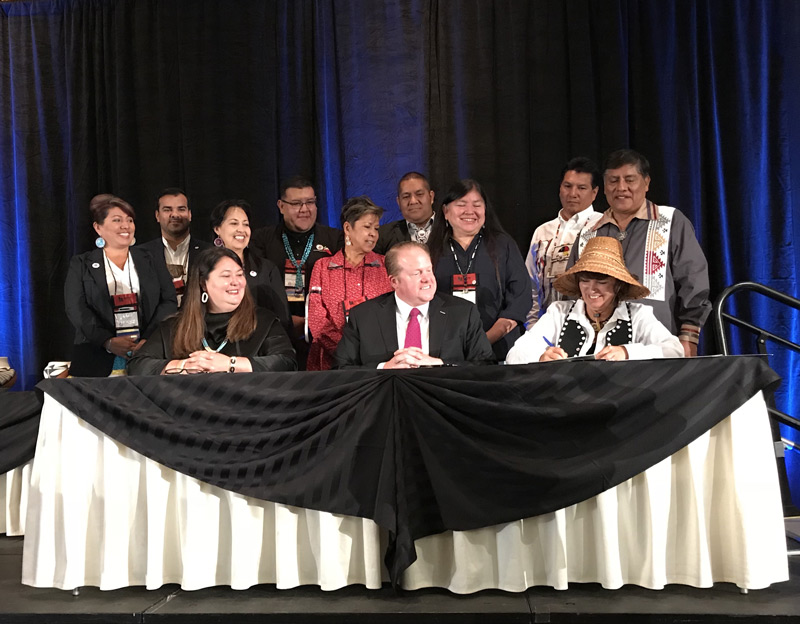

indianaffairs.gov
An official website of the U.S. Department of the Interior
Looking for U.S. government information and services?
Visit USA.gov