


<p>Office of Public Affairs</p>
Official websites use .gov
A .gov website belongs to an official government organization in the United States.
Secure .gov websites use HTTPS
A lock
()
or https:// means you’ve safely connected to the .gov website. Share sensitive information only on official, secure websites.
OPA
 Indian Affairs - Office of Public Affairs
WASHINGTON – Assistant Secretary of Indian Affairs Tara Katuk Sweeney today announced the establishment of the Bureau of Trust Funds Administration (BTFA) which will report directly to her office. The new BTFA will assume responsibility for financial operations and functions currently performed by the Office of the Special Trustee for American Indians (OST) effective today. The new Bureau will maintain the current OST fiduciary functions and reflects the Department of the Interior’s efforts to reform and modernize its accountability and management of Indian funds held in trust.
“Twenty-six years after Congress enacted the American Indian Trust Fund Management Reform Act of 1994, this Administration has finished the work necessary to modernize and professionalize the federal government’s handling of its fiduciary responsibilities for tribal and individual Indian trust fund accounts,” said Tara Sweeney, Assistant Secretary for Indian Affairs. “These reforms – the higher standard of care and best practices necessary for fulfilling the Secretary’s trust responsibility – must be institutionalized and made permanent. I am proud that this reorganization was accomplished consistent with President Trump’s vision to reorganize the federal government in a commonsense way, making the executive branch more lean, accountable, and efficient while still allowing the government to deliver core services.”
Established by the American Indian Trust Fund Management Reform Act of 1994 (Public Law 103-412), OST was created to improve the accountability and management of Indian funds held in trust by the federal government. As trustee, DOI has the primary fiduciary responsibility to manage both tribal trust funds and Individual Indian Money (IIM) accounts.
In evaluating the potential transition of these functions, the Department engaged in multiple meetings and forums with tribes and stakeholders. In addition, numerous formal government-to-government consultations were conducted and one Listening Session held throughout Indian Country as part of the implementation of the Indian Trust Asset Reform Act (ITARA) Section 304(a), codified at 25 U.S.C. § 5635, which requires that the Secretary prepare a transition plan and timetable for the termination of OST.
The mission of the Bureau of Trust Funds Administration is to manage the financial assets of trust beneficiaries. This effort is integrally related to DOI's goal of meeting its responsibilities to American Indians. BTFA carries out its mission in pursuit of the following vision—We Excel, Native America Prospers.
####
Indian Affairs - Office of Public Affairs
WASHINGTON, D.C. – Assistant Secretary – Indian Affairs Tara Katuk Sweeney announced today that the fifth of seven offices being established under the Operation Lady Justice Task Force to investigate cold cases involving missing and murdered American Indians and Alaska Natives will be located at the Gila River Indian Community Police Department in Sacaton, AZ. The Task Force’s first tribally housed cold case office opened August 13.
Advisor to the President Ivanka Trump joined Secretary of the Interior David L. Bernhardt for the launch of the first cold case office in Bloomington, MN, on July 27 highlighting President Trump’s commitment to forgotten men and women across our country and actions taken to end the violence against American Indians and Alaska Natives.
“I want to thank Governor Stephen Lewis for agreeing to house the Operation Lady Justice Task Force’s Phoenix cold case office at the Gila River Indian Community’s police department,” said Assistant Secretary Sweeney. “These cold case offices are a major development in addressing unsolved cases of missing and murdered American Indians and Alaska Natives that are heartbreaking for their families and communities.”
“The Gila River Indian Community is pleased to house the new Cold Case office for the Western Region. The entire Region will benefit from bringing together federal resources specifically designated to address this crisis of Missing and Murdered Native Americans,” said Gila River Indian Community Governor Stephen R. Lewis. “This is a positive first step in reinforcing the trust relationship between the federal government and tribal nations and addressing this longstanding issue in Indian Country. The Community looks forward to helping ensure the success of the Cold Case office within the Gila River Police Department.”
“The Hopi Tribe is thrilled to know the work of the recently established Operation Lady Justice Task Force will move forward with addressing the astounding number of cases of murdered and missing American Indians and Alaska Natives in Tribal communities,” said Hopi Tribal Chairman Timothy Nuvangyaoma. “We are looking forward to supporting our national law enforcement agencies with this much needed coordination and to continue advocating for those who have been silenced by the crimes against our native people.”
“The Paiute Indian Tribe of Utah is grateful that under Operation Lady Justice, MMIP Cold Case units are opening regionally and assisting Indian Country in identifying and finally finding closure for families that for years have not found justice or closure for their loved one,” said PITU Chairperson Tamra Borchardt-Slayton. “It has finally become a priority to finally address issues that are on-going with MMIP and the multitude of unresolved cases.”
“Native Americans, particularly women, suffer from disproportionately high levels of violence across the country—a crisis that is exacerbated by jurisdictional challenges and the lack of a unified national database to track indigenous missing persons cases,” said United States Senator Martha McSally. “In fact, Arizona has the third largest number of cases of missing and murdered indigenous women. This is unacceptable and our tribal communities deserve better. The establishment today of a Missing and Murdered Native Americans Cold Case Task Force office in Phoenix is a critical step toward delivering justice to our native populations.”
The Gila River Indian Community is located on the south side of the city of Phoenix in Pinal County, which is within the Phoenix metropolitan area. The cold case office will be co-located with the Gila River Indian Community Police Department and staffed by two agents from the Bureau of Indian Affairs Office of Justice Services (BIA-OJS).
“The Bureau of Indian Affairs’ Office of Justice Services works closely with its partners in tribal, state, local and federal law enforcement agencies to address violent crime in Indian Country communities,” said BIA Deputy Bureau Director for OJS Charles Addington. “I want to add my thanks to Governor Lewis and the Gila River Indian Community Police Department for their willingness to house the Operation Lady Justice Task Force’s Phoenix cold case office.”
In addition to Bloomington, cold case offices were opened in Rapid City, SD, on August 4; in Billings, MT, on August 6; and in Albuquerque, NM, on August 11, 2020. Future office openings are planned for Anchorage, AK, and Nashville, TN.
President Trump's Executive Order established the Operation Lady Justice Task Force, a multi-agency effort co-chaired by Secretary Bernhardt and U.S. Attorney General William P. Barr. Its purpose is to enhance the operation of the criminal justice system and address the staggering number of missing and murdered American Indians and Alaska Natives in tribal communities.
The cold case teams have been established in accordance with Executive Order 13898 which President Trump signed on November 26, 2019, to address this crisis. They will be staffed with law enforcement personnel and newly appointed special agents from the BIA-OJS.
A way for top federal officials to engage, coordinate and work with tribal governments on developing strategies to address the crisis, the Operation Lady Justice Task Force is working to collect and manage data across jurisdictions; establish protocols for new and unsolved cases; establish multi-jurisdictional cold case teams; improve the response to investigative challenges; and provide clarity on the roles, authorities and jurisdiction for those involved. It is also charged with providing a report to the President of its work and accomplishments in meeting the executive order’s mandate.
Since 2019, the Department of the Interior and the BIA have undertaken a number of efforts to address the crisis, conducting criminal investigations, stopping illicit drug activity and solving missing and murdered cases.
The BIA-OJS and its partners have opened 200 percent more drug cases across Indian Country than in the last year of the Obama Administration, and their tribal law enforcement officers have seized approximately 6,000 pounds of narcotics worth $30 million in the past two years. Preventing further violence against American Indians and Alaska Natives is largely predicated on ending illicit drug activities, alcohol abuse and sex trafficking.
The BIA-OJS's partnership with the U.S. Department of Justice’s National Missing and Unidentified Persons System, known as NamUs, has led to the development and implementation of new tribal-affiliation data fields to assist law enforcement with capturing information to track missing persons in Indian Country. Since the addition of these new data fields last year and NamUs’ extensive outreach to states with large tribal populations with the result that they are inputting data directly into the system, there has been a 60 percent increase in Native-person entries in NamUs.
The Assistant Secretary – Indian Affairs advises the Secretary of the Interior on Indian Affairs policy issues, communicates policy to and oversees the programs of the BIA and the BIE, provides leadership in consultations with tribes, and serves as the DOI official for intra- and inter-departmental coordination and liaison within the Executive Branch on Indian matters.
Indian Affairs - Office of Public Affairs
On behalf of the Office of the Assistant Secretary for Indian Affairs, the Bureau of Indian Affairs, and the Bureau of Indian Education, I extend our deepest sympathies and condolences to the late-Senator John McCain’s family. We appreciate their selfless willingness to share his short time on this earth with us to make our Nation better. We will miss his voice, but his spirit will live with us forever.
Over the entirety of Senator McCain’s career, he undoubtedly earned a great legacy built upon asking the tough questions and making tough decisions. As a member of the Senate Committee of Indian Affairs since 1987, which is one of our oversight committees, he often asked DOI Indian Affairs the tough questions involving the welfare of tribal communities. His mentor, the late-Congressman “Mo” Udall famously told Senator McCain, “Don’t forget the Indians,” and during his tenure he held true to that promise.
Senator McCain’s legacy has shaped the world in which we at Indian Affairs operate today. He was influential in development of the Indian Self-Determination Contract Reform Amendments, Trust Reform, the Indian Gaming Regulatory Act, and Indian Education. He was critical, yet thoughtful, of whether and how diligently the federal government carried out the trust responsibility, especially when it came to the future of our Native youth. The Senator commented in 2016, “I have been a member of this Committee for many, many years. We have not seen a significant improvement. It is not because of dedicated men and women who work in these BIE schools but it is a system, I think, that deserves some new approaches.” Although many competing recommendations exist for improving federal services provided to the American people, including our tribal communities, we hold a common end goal to create an improved system of delivery that upholds our trust responsibilities.
Senator McCain touched our lives. This week, DOI Indian Affairs staffers in the many stages of their careers shared stories about the late-Senator. Stories that I had personally heard ranged from his willingness to launch the careers of aspiring young Native students by offering internships in his Senate office and stories of how our program directors and staff contributed information to answer his tough questions. These stories have been a great tribute to his memory.
As the Chairman of the Senate Committee, he shared some heartfelt words that I hope we as federal public servants can find inspiration from, “While remembering our past wrongs is important, it is also important that we answer those wrongs with vigorous actions and policies that actively promote the well-being of Native Americans today.”
In closing, I want to thank the late-Senator for not only remembering the Indians, but for working hard to support and strengthen tribal sovereignty and tribal self-determination.
###
Indian Affairs - Office of Public Affairs
WASHINGTON – Assistant Secretary – Indian Affairs Tara Mac Lean Sweeney joined Mashantucket Pequot Tribal Nation Chairman Rodney A. Butler in a first-ever virtual signing ceremony on July 29, 2020, for the Nation’s 105(l) lease agreement with the Department of the Interior (DOI) under the Indian Self-Determination and Education Assistance Act of 1975 (ISDEAA) for a public safety facility.
Under the lease, DOI will provide funding for facility costs associated with the administration and delivery of law enforcement services, community fire protection and tribal court services.
“I congratulate Chairman Butler, the Mashantucket Pequot Tribal Council, and community members for this great achievement in self-determination and tribal sovereignty,” said Assistant Secretary Sweeney. “The Section 105(l) leasing program helps fulfill the Indian Self-Determination Act’s mandate for the Federal government to support tribal nations in their efforts to achieve self-sufficiency. We will continue to provide this opportunity to other tribes who would like to establish 105(l) lease agreements with us.”
“The Mashantucket Pequot Tribal Nation is proud to be one of the initial participants in the Department of the Interior’s section 105(l) leasing program under the Indian Self-Determination and Education Assistance Act, and the first tribal nation to enter into a lease as a Title I contracting Tribe,” said Chairman Butler. “The lease of our public safety facility is the type of self-determination partnership between tribal nations and the Department that was envisioned 45 years ago this month when the ISDEAA was enacted. I want to thank Assistant Secretary Sweeney for making this program a priority.”
Section 105(l) provides that tribes and tribal organizations carrying out federal functions under a self-determination contract or self-governance compact may enter into a lease agreement with DOI for the tribally owned or rented facility used to carry out those functions. Under a 105(l) lease, DOI negotiates with the tribe or tribal organization on eligible expenses for use of the facility to carry out the contract or compact function.
Today’s event marks the third 105(l) lease that DOI has signed with tribal governments, and the first in the Bureau of Indian Affairs (BIA) Eastern Region. The first and second signings were with tribes in the BIA’s Western and Midwest regions: In July 2019 with the Gila River Indian Community in Arizona for a K-8 Bureau of Indian Education-funded school facility on its reservation and the second in October 2019 with the Red Lake Band of Chippewa Indians in Minnesota for the operation and maintenance of its criminal justice complex.
On June 29 and July 1, 2020, Indian Affairs hosted listening sessions on the framework Indian Affairs will use for this type of lease. The lessons it has learned will be used to help guide negotiations for future 105(l) leases for these types of facilities.
The Assistant Secretary – Indian Affairs advises the Secretary of the Interior on Indian Affairs policy issues, communicates policy to and oversees the programs of the BIA and the BIE, provides leadership in consultations with tribes, and serves as the DOI official for intra- and inter-departmental coordination and liaison within the Executive Branch on Indian matters.
For Immediate Release: July 31, 2020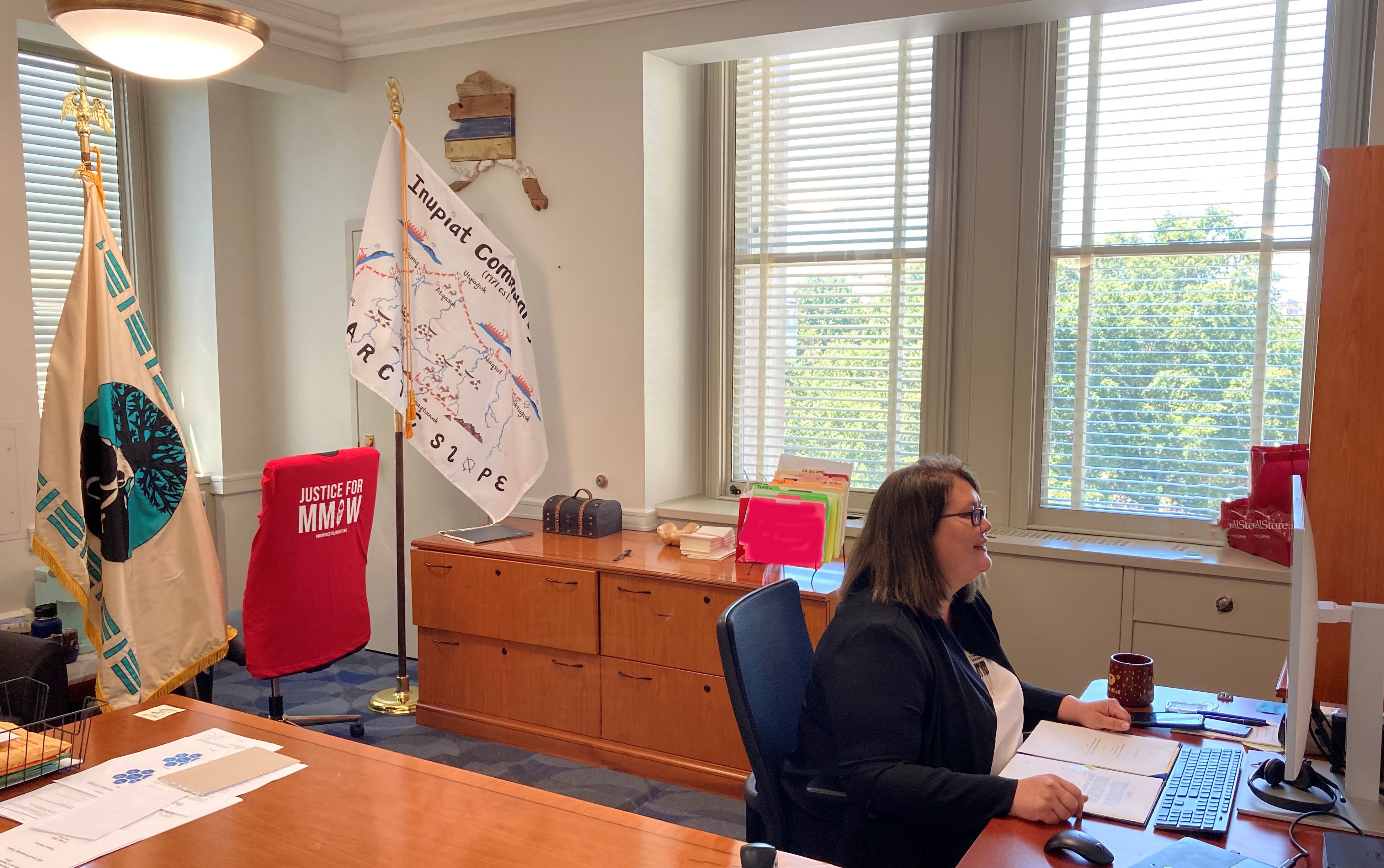 Indian Affairs - Office of Public Affairs
WASHINGTON - Today, Secretary of the Interior David Bernhardt highlighted another successful seizure of narcotics. While on patrol near the exterior boundaries of the Laguna Indian Reservation in New Mexico, a Bureau of Indian Affairs K-9 police unit arrested an individual and seized 85 pounds of narcotics worth more than $4 million dollars.
The K-9 police unit seized:
- 82.8 pounds (37,578.75 grams) of methamphetamine with a street value of $3,795,454;
- 2.44 pounds (1,110.58 grams) of heroin with a street value of $162,145; and
- 2,000 THC Concentrate cigarette cartridges with a retail value of $90,000
“I commend the Bureau of Indian Affairs’ law enforcement team and all of the dedicated men and women in uniform who protect Indian Country.” said Secretary Bernhardt. “The President has made it a priority to keep our communities safe and drug free. By working alongside our Native communities and other partners, we are doing everything we can to get these drugs off the streets; today’s announcement is another example of that progress.”
“I applaud the exemplary service demonstrated by K-9 Police Officer Nicholas Jackson and K-9 Kofi to safeguard our Nation’s communities, both tribal and non-tribal, from these addictive poisons, valued at more than 4 million dollars,” said Assistant Secretary Tara Katuk Sweeney. “The Interstates paved through our tribal lands are not save havens for drug runners. I am proud of the Bureau of Indian Affairs Office of Justice Services law enforcement officers for standing watch and making arrests.”
“Our BIA-OJS Officers continue to stand vigilant and ready to respond to any drug trafficking operations moving through Indian Country and I am proud of Officer Nick Jackson and K-9 Kofi’s for their continued success as a team,” said BIA-OJS Director Charles Addington. “Our BIA and Tribal law enforcement officers do an awesome job and are proud to serve and protect tribal communities every day.”
BACKGROUND
In FY 2018, the BIA-OJS led 15 operations in seven states, resulting in a total of 372 arrests and the total seizure of over 3,200 pounds of illegal narcotics with an estimated street value of approximately $9.8 million dollars.
Other Recent Seizures
Arizona –The Department’s Joint Task Force on Opioid Reduction seized approximately 30,000 fentanyl pills and more than a hundred thousand dollars’ worth of other illegal drugs during an operation in Arizona. This operation was related to a Bureau of Indian Affairs Drug Enforcement joint investigation into large amounts of fentanyl pills from a Mexican drug trafficking organization being transported into the U.S. through Points of Entry located on the Tohono O'odham Nation.
New Mexico – A Bureau of Indian Affairs K-9 unit was patrolling the interstate on the Laguna Pueblo when he conducted a traffic stop. Upon searching the vehicle, the BIA K-9 officer detected several packages containing more than $230,000 worth of marijuana and THC Concentrate.
Arizona – In February, the Opioid Task Force conducted a Criminal Interdiction Operation focused on areas known for high drug trafficking in and around the San Carlos Apache Reservation in Arizona. The DOI Opioid Task Force consisted of Special Agents from the Bureau of Indian Affairs, Division of Drug Enforcement and BIA K-9 uniformed officers, the San Carlos Apache Police Department, and the Bureau of Land Management. This operation capped a lengthy, two phased enforcement effort aimed at dismantling and disrupting the drug distribution networks targeting the San Carlos Apache Reservation. These investigations resulted in the combined purchase and seizure of approximately 417 grams of methamphetamine – estimated street value of $27,060 – which ultimately resulted in eighteen Federal Indictments.
Washington - A February 28 operation on the Spokane Reservation in Washington also resulted in the seizure of more than $200,000 worth of heroin and methamphetamine and two non-Indian subjects were arrested. On March 13, 2019, BIA Drug Enforcement, DEA, US Border Patrol and Mattawa Police Department seized approximately 2,107 grams (4.6 pounds) of methamphetamine from a residence known to be a source of supply to reservations in Washington State. The illegal narcotics seized had an estimated street value of approximately $105,350.
###
For Immediate Release: August 30, 2019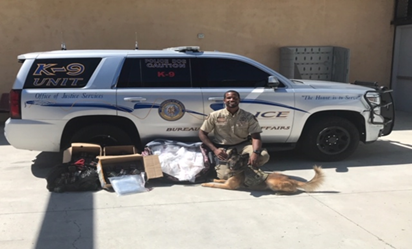 Indian Affairs - Office of Public Affairs
LAGUNA PUEBLO, NM— The U.S. Department of the Interior’s Bureau of Indian Affairs Office of Justice Services (BIA-OJS) Officer Nicholas “Nick” Jackson and his K-9 Kofi seized 4.3 Kilos (9.4 pounds) of heroin, which has an estimated street value of approximately $559,000.00, on the Pueblo of Laguna in New Mexico last week.
“I commend BIA-OJS Officer Jackson and his K-9 partner Kofi for their vigilance to get this poison out of Indian Country and off the streets,” said Secretary of the Interior David Bernhardt. “President Trump and I are committed to working alongside our Native communities to end the scourge of these drugs, which stems from supporting the work of our law enforcement officers who are the first line of defense in keeping citizens safe.”
“We are so proud of BIA-OJS Officer Jackson and K-9 Kofi for another big seizure,” said Assistant Secretary of the Interior Tara Sweeney. “The BIA is committed to its ongoing efforts to protect tribal communities from the opioid crisis.”
On June 5th, Officer Jackson and K-9 Kofi were assigned to traffic enforcement on Interstate 40, within the exterior boundaries of the on the Pueblo of Laguna in New Mexico. BIA-OJS Officer Jackson observed two rental vehicles traveling in tandem and attempted to catch up to one of the vehicles for the traffic violation. The other vehicle began to drive erratically in an attempt to draw Officer Jackson's attention away from the first vehicle as the first vehicle accelerated in an attempt to flee.
The driver threw two white-colored bags out of the rear passenger window. Once the vehicle came to a stop, the driver exited the vehicle and began to flee on foot. After several commands to stop and surrender, K-9 Kofi apprehended the driver and was taken into custody by Officer Jackson.
A New Mexico State Police Officer arrived at the scene where Officer Jackson provided a briefing of events, including the driver discarding the white bags on the interstate. The state officer searched the area around mile maker 126 and located the white-colored grocery bags containing what later field-tested positive for the presence of heroin.
The investigation is ongoing by BIA-OJS DDE and Homeland Security Investigations (HSI).
Background
In FY 2018, the BIA-OJS led 15 operations in seven states, resulting in a total of 372 arrests and the total seizure of over 3,200 pounds of illegal narcotics with an estimated street value of approximately $9.8 million dollars.
For Immediate Release: June 12, 2019
 Indian Affairs - Office of Public Affairs
WASHINGTON – Assistant Secretary – Indian Affairs Tara Mac Lean Sweeney will address the 28th Annual Indian Country Law Enforcement Officer’s Memorial Service taking place Thursday, May 2, 2019, at the United States Indian Police Academy in Artesia, N.M.
The Indian Country Law Enforcement Officer’s Memorial Service honors tribal, state, local and federal law enforcement officers who have given their lives in the line of duty while serving on federal Indian lands and in tribal communities. It is also the occasion when the names of officers to be added to the Indian Country Law Enforcement Officer’s Memorial monument at the academy are formally announced.
The 28th Annual Indian Country Law Enforcement Officer’s Memorial Service will be live-streamed. To view the event, visit the service’s website and type in the password “biamemorial.”
WHO: Tara Mac Lean Sweeney, Assistant Secretary – Indian Affairs, U.S. Department of the Interior (DOI); Master of Ceremony Charles Addington, Deputy Bureau Director, BIA-Office of Justice Services, DOI; Thomas J. Walters, Director, Federal Law Enforcement Training Center (FLETC), Glencoe, Ga.; Bill Denke, Indian Section Chairman, International Association of Chiefs of Police (IACP).
WHAT: Assistant Secretary Sweeney will address attendees to the 28th Annual Indian Country Law Enforcement Officer’s Memorial Service where the names of three fallen law enforcement officers will be added to the memorial.
WHEN: Thursday, May 2, 2019, at 10:00 a.m. MDT.
WHERE: BIA Indian Police Academy, DHS Federal Law Enforcement Training Centers, 1300 West Richey Avenue, Artesia, N.M. Phone (505) 748-8151 for directions.
CREDENTIALS: This invitation is extended to working media representatives, who are required to display sanctioned media credentials for admittance to the event. Press seating will be provided. Credentialed media covering the event should be in place by 9:45 a.m. for the program beginning at 10:00 a.m.
To view an image of the Indian Country Law Enforcement Officer’s Memorial and a list of the officers’ names inscribed on it, visit the FLETC website.
The event is held annually on the first Thursday in May. BIA-OJS conducts the memorial service in conjunction with IACP’s Indian Country Law Enforcement Section and other law enforcement organizations and agencies including the National Sheriffs’ Association and the U.S. Department of Homeland Security Federal Law Enforcement Training Centers in Artesia, where the monument, academy and memorial service are located. The names of three officers will be added at this year’s ceremony bringing the total number listed on the memorial to 119:
- Sac & Fox Nation Police Department Officer Nathan B. Graves who, on January 24, 2017, was killed when his patrol car was struck head-on by an oncoming vehicle that was attempting to pass another car.
- Omaha Nation Law Enforcement Services Police Sergeant Uga’shon Curtis W. Blackbird who, on March 26, 2017, was killed in a vehicle crash that occurred when he was responding to a call and, while driving along a closed section of Nebraska Highway 94 in a period of dense fog, his patrol car struck a construction crane.
- Salt River Police Department Officer Clayton Joel Townsend who, on January 8, 2019, was struck and killed while approaching a vehicle on a traffic stop. The subject driver who struck him admitted to texting and driving at the time of the crash.
-DOI-
Indian Affairs - Office of Public Affairs
Commissioner of Indian Affairs Morris Thompson has announced the appointment of Joe M. Parker, a Chickasaw Indian, as Superintendent of the Bureau of Indian Affairs Tahlequah, Oklahoma Agency. Parker, who has been Acting Superintendent at the Agency since January 12, replaces Joe Ragsdale who has retired.
A native of Ada, Oklahoma, Parker graduated from East Central state College of Oklahoma in 1960 with a degree in economics and accounting. He worked as an Internal Revenue Agent until 1973 when he moved to the Bureau of Indian Affairs as an accountant in the Area Office at Muskogee, He subsequently was a Program Analyst and the Accounting Officer Oklahoma for the Muskogee Area.
Parker, 42, served four years in the United States Navy. He has twice received awards for sustained superior performance in his work
Indian Affairs - Office of Public Affairs
The Administration's Water Policy Message sent to Congress today by President Carter recommended that States put up a front-end share of the cost of all Federal water projects.
The President said that State governments should assume a share of the cost over and above existing cost-sharing of Federal water projects. The proposal was among several initiatives the President announced to achieve a new national emphasis on water conservation, enhance Federal State cooperation, increase attention to environmental quality, and improve Federal water resource programs.
Secretary of the Interior Cecil D. Andrus, in a follow-up comment, strongly endorsed the President's recommendation that States share up-front costs of water projects.
"By contributing to the initial costs of water projects, States will exercise great influence over the location of Federal dams as well as play a leading part in deciding the priority rights of projects," Andrus said.
For project purposes with vendible outputs, such as water supply or hydroelectric power States would contribute 10 percent of the costs, proportionate to and phased with Federal appropriations.
For project purposes without vendible outputs, such as flood control, States' financing share would be 5 percent.
There would be a limit on State participation of 1/4 of 1 percent of the State's general fund revenue per project per year, so that a small State would not be precluded from having a very large project located in it.
"Cost-sharing will occupy a critical role in the President's new water policy," Andrus said. "It is a genuine reform that will assure more even-handed cooperation between States and the Federal Government."
The State cost sharing proposal would apply on a mandatory basis to projects not yet authorized. However, for projects in the authorized backlog, States which voluntarily enter into cost-sharing arrangements would achieve expedited consideration and priority for project funding, as long as other project planning requirements were met.
Soil Conservation Service projects will be completely exempt from the State cost-sharing proposal, the President said.
Specific initiatives spelled out for Federal agencies include:
Adding water conservation as consideration in the Principles and Standards which govern the planning of water resource projects.
- Making water conservation a condition of the municipal water supply and sewage treatment programs of the Environmental Protection Agency and the Departments of Agriculture and Commerce.
Integrating water conservation into the housing programs of the Departments of Housing and Urban Development, Veterans Administration, and Department of Agriculture.
Using existing programs of the Departments of the Interior, Agriculture, and Housing and Urban Development to provide technical assistance to farmers and urban dwellers on how to conserve water. Requiring water Conservation in Federal buildings and facilities. Asking all Federal agencies to examine and implement appropriate opportunities for water conservation.
The president also recommended that Congress provide $25 million annually in matching grants for technical assistance to States for water conservation purposes.
Environmental protection initiatives in the message included a directive to the Secretary of the Interior and other Federal agencies to vigorously implement the Fish and Wildlife Coordination Act and other environmental statutes; implementation of Executive Order 11988 on flood plain management; cooperation with States to protect instream flows and groundwater through provision of data and where possible, operation of Federal projects.
Indian Affairs - Office of Public Affairs
WASHINGTON – Today President Donald Trump proposed a $936.3 million Fiscal Year (FY) 2020 budget for the Department of the Interior’s Bureau of Indian Education (BIE).
The BIE’s primary mission is to provide quality education opportunities from early childhood through life in accordance with a tribe’s need for cultural and economic well-being, in keeping with the wide diversity of American Indian and Alaska Native tribes as distinct cultural and governmental entities.
For the first time in its history, the BIE’s budget request is being presented in a separate budget justification. All BIE budget activities are shifted out of Indian Affairs’ Operation of Indian Programs account into a new Operation of Indian Education Programs account. In addition, the Education Construction budget activity is shifted to a new Education Construction account.
“The President’s Fiscal Year 2020 budget for the Bureau of Indian Education supports his goals for tribal self-determination by improving education services to Indian Country,” said Acting Interior Secretary David L. Bernhardt. “This budget recognizes the BIE being as important to tribes in the education of their children as the BIA is to supporting them in the management of their trust lands and resources.”
“I appreciate the President’s recognition through his FY 2020 proposal of the need to elevate the BIE budget to bureau-level status within the overall Indian Affairs budget, given its broad range of responsibilities for educating our students,” said Assistant Secretary – Indian Affairs Tara “Katuk” Sweeney. “Our children are sacred and we’re fighting for their futures. That is why having the BIE budget as a separate account will allow for greater transparency and accountability for our education responsibilities.”
The 2020 budget acknowledges the distinct and separate responsibilities and missions of Indian Affairs’ two bureaus – BIE and the Bureau of Indian Affairs (BIA) – by elevating the BIE budget request to the bureau level and presenting it separately from the BIA’s. This proposal will advance BIE reform, provide autonomy and accountability, streamline services, maximize efficiency, and build capacity.
The request also supports the Administration’s commitment to helping promote tribal nation-building and self-determination, empower tribal communities, foster tribal self-sufficiency, create educational and economic opportunities, ensure safe Indian communities, and preserve and foster cultural heritage. The goals and vision reflected in the FY 2020 budget are informed by tribal leaders and the Tribal-Interior Budget Council (TIBC) who helped the Department identify the priorities in this request.
Budget Overview: The President’s FY 2020 budget for BIE is $936.3 million in current appropriations.
The Bureau manages the Federal school system comprised of 169 elementary and secondary schools and 14 dormitories, located on 64 reservations in 23 States, providing educational services to 46,692 individual students, with an Average Daily Membership of 40,641 students. It also operates two post-secondary schools and administers grants for 29 tribally controlled colleges and universities and two tribal technical colleges.
BIE funding supports classroom instruction, student transportation, native language instruction, cultural enrichment, gifted and talented programs, and school improvement and maintenance. In some schools, funding also supports residential costs, mostly in remotely located sites. And, because the BIE functionally serves as a State Education Agency (SEA), it administers and oversees U.S. Department of Education programs in BIE-funded schools, and receives additional Education Department funds to educate and provide services to students attending these schools.
The FY 2020 budget request prioritizes direct school operations, school improvement, early childhood programs, and completing the Bureau’s reform efforts to improve service and technical assistance for BIE-funded schools. Staffing is estimated at 2,448 full time equivalents in 2020.
Operation of Indian Education Programs: The FY 2020 budget for the Operation of Indian Education Programs account is $867.4 million. In 2020, priority is given to sub-activities providing for direct school operations and school improvement in line with the BIE’s Strategic Direction plan.
Foster Tribal Student Success – The FY 2020 budget proposes to accomplish this in two ways: 1) By serving as a capacity builder and service provider to support tribes in delivering culturally appropriate education with high academic standards to allow students across Indian Country to achieve success, and 2) By prioritizing funding for core mission programs and operations at BIE-funded elementary and secondary schools and tribally controlled colleges and universities. The request includes:
- $726.8 million for Elementary and Secondary programs,
- $98.0 million for Post-secondary programs, and
- $42.6 million for Education Management.
The FY 2020 budget request’s focus on direct school operations, which includes classroom instruction, student transportation, Native language development programs, cultural awareness and enrichment, school improvement and maintenance, and in some remotely located schools, residential costs, reflects its continuing investment in activities that promote educational self-determination for tribal communities. The request includes $81.5 million for Tribal Grant Support Costs for tribes that choose to operate BIE-funded schools themselves – a funding level that supports 100 percent of the estimated requirement.
BIE Reform Efforts – The FY 2020 budget proposes $32.3 million in education program management funds to improve service to BIE-funded schools and build in-house capacity and accountability.
Tribal Priority Allocations – The FY 2020 budget proposes Tribal Priority Allocation funding of $16.1 million.
Compliance with the Every Student Succeeds Act – Funding from the Department of Education would provide for continued implementation of the Act and help BIE establish high quality standards, accountability and capacity to invest in meaningful assessments.
Construction: The FY 2020 budget proposes to shift the Education Construction budget activity to a new Education Construction account and requests $68.9 million in annual funding for this activity.
Funding will continue to focus on facility improvement and repairs at existing BIE-funded schools. In addition, available funding from prior years will enable work to continue on completing construction on schools listed on the Bureau’s Replacement School Construction Priority List published in the Federal Register on March 24, 2004, and to begin design and construction phases for schools listed on a subsequent list published on April 29, 2016.
The Assistant Secretary–Indian Affairs advises the Secretary of the Interior on Indian Affairs policy issues, communicates policy to and oversee the programs of the BIA and the BIE, provides leadership in consultations with tribes, and serves as the DOI official for intra- and inter- departmental coordination and liaison within the Executive Branch on Indian matters.
The Bureau of Indian Affairs’ mission includes developing and protecting Indian trust lands and natural and energy resources; supporting social welfare, public safety and justice in tribal communities; and promoting tribal self-determination and self-governance.
The Bureau of Indian Education implements Federal Indian education programs and funds 183 elementary and secondary day and boarding schools (of which two-thirds are tribally operated) located on 64 reservations in 23 States and peripheral dormitories serving nearly 47,000 individual students. The BIE also operates two post-secondary schools and administers grants for 29 tribally controlled colleges and universities and two tribal technical colleges.
####

indianaffairs.gov
An official website of the U.S. Department of the Interior
Looking for U.S. government information and services?
Visit USA.gov