


<p>Office of Public Affairs</p>
Official websites use .gov
A .gov website belongs to an official government organization in the United States.
Secure .gov websites use HTTPS
A lock
()
or https:// means you’ve safely connected to the .gov website. Share sensitive information only on official, secure websites.
OPA
 Indian Affairs - Office of Public Affairs
WASHINGTON – U.S. Secretary of the Interior Ryan Zinke today thanked President Trump for signing a Presidential Emergency Declaration for the Seminole Tribe of Florida, which was hard hit by Hurricane Irma last week. The tribe made its request to the Federal Emergency Management Agency (FEMA) as soon as it was able to do so. This is the first such declaration ever approved for a tribal nation according to FEMA.
“I want to thank President Trump for quickly responding to the Seminole Tribe’s request for a Presidential Emergency Declaration to help it address the severe damage it suffered from Hurricane Irma,” Secretary Zinke said. “The Interior Department and, specifically, the Bureau of Indian Affairs are actively working to provide the tribe with law enforcement and emergency services that will help fill in gaps in its own resources and supplement the assistance it receives from FEMA.”
The declaration came with a surge of 75 volunteer officers from the Department of Interior, the Bureau of Indian Affairs, various other Interior bureaus, and other Tribal Nations. Two dozen BIA and tribal officers remain this week to provide law enforcement and emergency services.
The Seminole Tribe is headquartered in the city of Hollywood, and is one of two federally recognized tribes in the state of Florida. The Tribe has tribal members on the Hollywood, Big Cypress, Brighton, Immokalee, Fort Pierce, Lakeland and Tampa Reservations as well as communities in Naples, Tamiami Trail, and around the central Florida area.
“To be able to have the relationship with the federal government to ensure the support and safety of all Seminole Tribe of Florida Reservations and our members is a testament to the relationship of two sovereign governments,” said Seminole Chairman Marcellus Osceola. “I would like to thank President Donald Trump for his commitment to deploy all necessary resources to assist the Seminole Tribe of Florida during this difficult time.”
“The President’s fast response to the Seminole Tribe’s request for an emergency declaration was critical for the tribe to receive the assistance it needs to recover from the effects of Hurricane Irma,” said Principal Deputy Assistant Secretary – Indian Affairs John Tahsuda III. “By specifically asking for BIA law enforcement personnel to help relieve the Seminole tribal police officers, who have been on duty for over a week straight, the declaration allows us to move forward quickly to render such assistance and protect lives and property.”
With the President’s action, the BIA’s Office of Justice Services (OJS) will be able to provide law enforcement officers to support the Tribe under a Direct Federal Assistance (DFA) mission. The mission is being staffed by the BIA and supplemented by tribal and DOI law enforcement officers. The Bureau sent radio technicians to the site along with staff who delivered mobile sleeping quarters for mission personnel. BIA and other DOI Bureaus deployed 75 of the 125 personnel approved under the mission to support the Seminole Tribe at the Big Cypress, Brighton, Immokalee and Hollywood Reservations
The BIA’s Emergency Management office is leading a Tribal Assistance Coordination Group (TAC-G), which is responsible for coordinating emergency management actions of federal and state agencies, as well as volunteer organizations and other TAC-G partners, in support of tribes in Texas and Louisiana impacted by Hurricane Harvey and those impacted by Hurricane Irma.
###
Indian Affairs - Office of Public Affairs
WASHINGTON – U.S. Secretary of the Interior Ryan Zinke today announced the selection of Bryan Rice, a veteran federal administrator and citizen of the Cherokee Nation of Oklahoma, as the new Director of the Bureau of Indian Affairs (BIA), the federal agency that coordinates government-to-government relations with 567 federally recognized tribes in the United States.
“Bryan has a wealth of management expertise and experience that will well serve Indian Country as the BIA works to enhance the quality of life, promote economic opportunity, and carry out the federal responsibility to protect and improve the trust assets of American Indians, Indian tribes and Alaska Natives,” Secretary Zinke said. “I have full confidence that Bryan is the right person at this pivotal time as we work to renew the department’s focus on self-determination and self-governance, give power back to the tribes, and provide real meaning to the concept of tribal sovereignty.”
“Secretary Zinke’s naming of Bryan Rice as director of the BIA brings an accomplished individual to that post who is well-versed in the Bureau’s mission and has extensive knowledge about its work, particularly in the area of forestry and combatting wildland fires,” said Acting Assistant Secretary – Indian Affairs John Tahsuda. “Bryan will be a strong leader for the Bureau and closely follow the Secretary’s plans for reforming the BIA into a top-notch service delivery agency for tribes and tribal leaders.”
“Native Americans face significant regulatory and bureaucratic hurdles to economic freedom and success,” Rice said. “I am honored to accept this position and look forward to implementing President Trump’s and Secretary Zinke’s regulatory reform initiative for Indian Country to liberate Native Americans from the bureaucracy that has held them back economically.”
Rice, who will start his new position on Monday, October 16, 2017, recently led Interior’s Office of Wildland Fire, and has broad experience leading Forestry, Wildland Fire, and Tribal programs across Interior, BIA, and the U.S. Department of Agriculture. His federal government career has spanned nearly 20 years, beginning with service on the Helena Interagency Hotshot Crew for the U.S. Forest Service in Montana. He served as a Peace Corps Volunteer in Nepal, working in both community forestry and rural development and supervised numerous timber operations as a timber sale officer on the Yakama Reservation as well as a forester on the Tongass National Forest in Alaska. Rice also served in leadership capacities internationally in Tanzania, Mexico, Brazil and Australia for both Interior and the U.S. Forest Service.
Rice has served in two Senior Executive Service natural resources management leadership positions, including as Deputy Director for the BIA Office of Trust Services from 2011 to 2014, and as Director of Forest Management in the U.S. Forest Service from 2014 to 2016.
Rice spent his school years in the Midwest in Whitewater, Wisconsin and Peoria, Illinois.
He holds a Bachelor of Science degree in Forestry from the University of Illinois at Urbana-Champagne and a Master of Business Administration from the University of Alaska – Southeast, focusing on rural development and transportation systems. He is a licensed pilot, and enjoys time outside hunting and fishing.
Secretary Zinke also announced that Jeff Rupert will be the acting Director of the Office of Wildland Fire starting on Monday, October 16. Rupert was the chief of the Division of Natural Resources for the National Wildlife Refuge System, overseeing the Fire Management, Refuge Resource and Private Lands programs. He has been an active member of the Interior Fire Executive Council for the last several years. He is a graduate of Class #18 from the Interior Senior Executive Service Candidate Development Program and holds a Bachelor of Science degree in Biology from Baker University and a Master of Science degree in Biology from the University of Texas – Pan American.
The BIA carries out its core mission through four offices: the Office of Indian Services operates the BIA's general assistance, disaster relief, Indian child welfare, tribal government, Indian Self-Determination, and reservation roads programs; the Office of Justice Services directly operates or funds law enforcement, tribal courts, and detention facilities on Federal Indian lands; the Office of Trust Services works with tribes and individual American Indians and Alaska Natives in the management of their trust lands, assets, and resources; and the Office of Field Operations oversees 12 regional offices and 83 agencies which carry out the BIA mission at the tribal level. In Fiscal Year 2017, the BIA had 4,794 employees and a budget of $1.9 billion.
###
Indian Affairs - Office of Public Affairs
WASHINGTON – Today, U.S. Interior Secretary Ryan Zinke applauded President Donald J. Trump's nomination of Tara Mac Lean Sweeney, a prominent Alaska Native leader and acclaimed businesswoman with the Arctic Slope Regional Corporation, to be the department’s next Assistant Secretary for Indian Affairs.
If confirmed by the U.S. Senate, Sweeney, a member of the Native Village of Barrow and the Iñupiat Community of the Arctic Slope, would be the first Native Alaskan and only the second woman in history to hold the position.
The Assistant Secretary for Indian Affairs oversees Interior’s manifold responsibilities to enhance the quality of life, promote economic opportunity and provide quality educational opportunities for American Indians, Indian tribes and Alaska Natives, while protecting and improving their trust assets.
“Tara is a results-driven team leader and coalition builder who has an impressive combination of business acumen and service to her community,” Secretary Zinke said. “Her lifelong active engagement in Native American policy development and her outreach, advocacy, and organization skills are the combination we need to carry out the President’s reform initiative for Indian Country. I look forward to welcoming her to our leadership team."
“I am honored to be nominated to serve Indian Country in this capacity,” Tara Sweeney said. “My goal is to develop strong relationships with Tribes, Alaska Native corporations and Native Hawaiian Organizations to work on innovative solutions for lifting up our communities. I am motivated to work with Indian Country to find efficiencies inside the Bureau of Indian Affairs, improve service delivery and culturally relevant curriculum in the Bureau of Indian Education, and create a more effective voice for Tribes throughout the Federal Government. I am humbled by the confidence President Trump and Secretary Zinke have shown in me and ready to serve.”
“Secretary Zinke’s nomination of Tara Sweeny for Assistant Secretary of Indian Affairs taps a strong advocate for Native American self-determination and tribal self-government for this key leadership position,” said Acting Assistant Secretary of Indian Affairs John Tahsuda. “Her extensive organizational knowledge and collaborative management experience will well serve Indian Country by reforming federal policies, empowering tribal communities, and removing barriers to their economic advancement.”
Sweeney grew up in rural Alaska and has spent a lifetime actively engaged in state and national policy arenas focused on advocating for responsible Indian energy policy, rural broadband connectivity, Arctic growth and Native American self-determination. She has served her Arctic Slope Regional Corporation and its subsidiaries in a variety of capacities for nearly two decades. The $2.6 billion corporation is the largest locally-owned and operated business in Alaska, with about 13,000 Iñupiat Eskimo members and 12,000 employees worldwide. It is diversified in six major business sectors, including energy support services, industrial services, construction, petroleum refining and marketing, government services, and resource development.
In her current role as the Executive Vice President of External Affairs, she is responsible for all facets of government affairs and corporate communications. Her primary responsibilities include strategic policy and position development, implementation and execution; engagement with federal and state executive and legislative branches on improving policies affecting Indian energy, taxation, resource development, government contracting, broadband development and access to capital; as well as all facets of corporate communication as official company spokesperson, including stakeholder engagement and coalition building.
Sweeney also has served in leadership positions on numerous business and nonprofit boards at both the state and national level, including chair of the Arctic Economic Council from 2015 to 2017; co-chair of the Alaska Federation of Natives (2013); Coast Guard Foundation Board of Trustees; the University of Alaska Foundation Board of Trustees; FCC Advisory Committee on Diversity for Communications in a Digital Age; Analytical Services, Inc.; Kohanic Broadcast Corporation (parent to the first Native American owned, publicly supported FM radio station); Cherokee Nation New Market Tax Credit Advisory Board (CNB Economic Development Company, LLC, beneficiary); Breast Cancer Focus, Inc.; and Arctic Power.
“I extend my congratulations and full support to Tara on her nomination to serve as Assistant Secretary,” Senator Lisa Murkowski said. “Tara has a very strong record of professionalism and accomplishment in Alaska, across the country, and internationally, especially with the indigenous people of the circumpolar north. She has significant experience on Arctic issues and chaired the Arctic Economic Council. She is an expert on energy, infrastructure, broadband, economic development, Native self-determination, and a wide range of policy issues that will come before her. Secretary Zinke could not have chosen a better leader to help him fulfill the federal government’s trust responsibility, and I know Tara has the heart and drive to excel in this position.”
“This is a historic appointment for Alaskans and for the country,” Senator Dan Sullivan said. “I’ve worked with Tara Sweeney for years and I have witnessed first-hand her integrity, her strong leadership skills and her devotion to public service. Tara has a deep love for our state and people, and is relentless in her commitment to securing a better future for Alaska and the nation. With her long history of advocating for Alaska Native cultural values, rights, and economic opportunity, I can’t think of anyone better to have as our nation’s next Assistant Secretary for Indian Affairs.”
“This is an absolutely outstanding choice,” said Congressman Don Young.“Tara’s knowledge, experience and leadership will go a long way in straightening out the BIA, allowing it to run more efficiently for the good of all First Americans. She has extensive experience not only in business, but also within Alaska Native groups and organizations. Tara knows first-hand the fight for Native empowerment and self-determination because she’s been on the front lines for years. There’s long been a problem with Native issues not receiving the priority they deserve but with Tara Sweeney at the helm, I have no doubt the Department of Interior will be paying close attention and the voices of our Native communities will be heard. Tara follows in great Alaskan footsteps, those of my dear friend Morris Thompson, and will do a fantastic job working on behalf of American Indians and Alaska Natives across the country.”
“Tara’s selection for this position is cause for celebration in Alaska. In each of my conversations with Secretary Zinke, I have encouraged him to include Alaskans for significant roles in his department,” said Governor Walker. “Tara’s leadership in seeking self-determination and economic development for the people of the Arctic has been exemplary. As an Inupiaq tribal and corporate leader, she has sought the necessary balance between economic development and sustaining the ways of life and cultures of Alaska’s First People. While many will be sad to see her leave ASRC, Tara’s expertise will serve our state and nation well in this new role.”
"I commend the Secretary for his choice of Tara Sweeney for the Position of Assistant Secretary," said Jackie Johnson Pata with the National Congress of American Indians. "Tara's diverse experience in the areas of energy, natural resources, and tribal governance will be a welcome addition to the Department of Interior and NCAI looks forward to working with Tara in her new capacity."
“Since March when he was sworn in, Secretary Zinke has been assembling a top-notch team of professionals to help him lead the Interior Department,” said John Berrey, Chairman of the Quapaw Tribe in Oklahoma. “With Tara Sweeney’s nomination, the Secretary is showing he means business when it comes to reforming the BIA and improving the delivery of services to Indian people. Tara’s long and dedicated service to the Alaska Federation of Natives, the Arctic Slope Regional Corporation and, most recently, the Arctic Economic Council, will be what is needed in the BIA’s top official. I thank the secretary for this nomination and pledge to help Tara achieve success for Native people any way I can.”
“Ms. Sweeney’s background consists of the right elements to assist our economic development efforts with the tribes we serve in Montana, Wyoming, North and South Dakota towards economic sustainability,” said Leonard Smith, Executive Director of the Native American Development Corporation. “Her experience in energy, capital, government contracting and economic development give her the depth of knowledge to develop legislative solutions to federal policies that hinder economic development with tribal nations. We feel confident she will be able to promote stronger federal support through collaboration with other federal, state and private resources for implementation of the infrastructure necessary for economic growth and sustainability.”
“In these critical times, Ms. Tara Sweeney will serve as a strong Assistant Secretary for Indian Affairs,” said Julie Kitka, President of the Alaska Federation of Natives. “Her experience with empowering Native Americans is unparalleled and she will help all tribes achieve great self-determination. There is not a Tribe or Alaska Native corporation that she would not help. I have had the opportunity to work alongside Ms. Sweeney for over a decade, I’ve seen her in action and she is driven by results.”
"Ms Sweeney is an incredibly qualified nominee," said Robin Puanani Danner, the Policy Chair for the Council for Native Hawaiian Advancement. "Her business experience, the cultural grounding of her Inuit people, and her keen understanding of living in some of the most remote Native areas in the country will serve all first peoples in her role at the department of interior."
“Tara is a dedicated, hard-working and fearless leader focused on providing value and real results across local, national and international boundaries,” said Gabriel Kompkoff, President of the ANCSA Regional Association, the membership association of Alaska Native Regional Corporation CEOs. “Her passion shows through in every challenge she faces.”
Among her honors, Sweeney -- a lifetime member of the National Congress of American Indians -- was crowned Miss NCAI in 1993 and traveled the country as an ambassador for the organization. In 2003, Governor Frank Murkowski recognized Sweeney’s passion for rural Alaska, appointing her to his cabinet as Special Assistant for Rural Affairs and Education. In 2008 she was honored as a “Top Forty Under 40″ business leader by the Alaska Journal of Commerce. In 2014 her team was honored by the Northwest Regional Emmy® Awards, for its IAM IÑUPIAQ commercial campaign 2014, and also served as co-chair for Senator Dan Sullivan’s (R-AK) successful Senate campaign. In 2017 she was inducted into the Anchorage ATHENA Society, a program of the Anchorage Chamber of Commerce that encourages the potential of women as valued members and leaders of the business community.
Born to Dr. Bryan Mac Lean and the Late Representative Eileen Panigeo Mac Lean, Sweeney is the granddaughter of the Late May Ahmaogak Panigeo and the Late Henry Panigeo of Barrow. She is the great granddaughter of the Late Bert and Nellie Panigeo and Isabel and Dr. Roy Ahmaogak. She was raised, attended schools and lived most of her life in rural Alaska in villages from Noorvik to Wainwright, Barrow, Bethel, and Unalakleet. She graduated from Barrow High School in 1991. A 1998 graduate of Cornell University School of Industrial and Labor Relations with a Bachelor of Science Degree, Sweeney currently lives in Anchorage with her husband Kevin, and their two children, Caitlin and Ahmaogak.
Through its Bureau of Indian Affairs (BIA) and Bureau of Indian Education (BIE), Interior provides services (directly or through contracts, grants or compacts) to 1.9 million American Indians and Alaska Natives. There are 567 federally recognized American Indian tribes and Alaska Native corporations in the United States. The BIE provides education services to about 42,000 Indian students. The Indian trust, co-managed by BIA and the Office of the Special Trustee, consists of 55 million surface acres and 57 million acres of subsurface mineral estate. More than 11 million acres belong to individual Indians and nearly 44 million acres are held in trust for Indian tribes. On these lands, the Department manages more than 122,817 revenue-producing leases. In conjunction with the Department of the Treasury, Interior, also manages about $4.9 billion in Indian trust funds. In Fiscal Year 2016, $1.2 billion was received into and disbursed from tribal and individual Indian beneficiaries’ accounts.
###
Indian Affairs - Office of Public Affairs
WASHINGTON – The Department of the Interior announced today it is taking the final steps in its efforts to identify the whereabouts of approximately 17,000 Native Americans to provide compensation as part of the Cobell settlement. The settlement of the Cobell lawsuit has reached an important deadline and the Department needs Class Members, or the heirs of Class Members, to provide documentation of their status to the Office of the Special Trustee for American Indians (OST) and/or the Garden City Group (GCG), the Cobell claims administrator, by November 27, 2017, which is a court-imposed deadline for claiming settlement compensation so that payment may be made.
In 1996, Elouise Cobell, a member of the Blackfeet Tribe, and four other Native American representatives filed a class-action lawsuit against two departments of the United States government: the Department of the Interior and the Department of the Treasury. The plaintiffs claimed that the government had incorrectly accounted for income derived from Indian trust assets, which are legally owned by the U.S. government but held in trust for individual Native Americans (the beneficial owners).
In 2009, the parties to the suit negotiated a settlement in the case, and in 2010 Congress passed implementing legislation designating $3.4 billion for the settlement: $1.4 billion was allocated to be paid to the plaintiffs and $1.9 billion was allocated for a Land Buy-Back Program and a newly created educational scholarship fund for American Indian and Alaska Native students.
The settlement payment process is being handled by the GCG with the cooperation of the Interior Department. Class members all over the country have received detailed information about their legal rights and options via the United States Postal Service. Information was also provided through an extensive media campaign which included Native America print media, social media, television and radio ads, and online advertising.
The bulk of the settlement monies have already been paid to individual Indians. Despite extensive efforts to contact all potential claimants, there still remain several thousand Individual Indian Money (IIM) account holders who are classified as “whereabouts unknown" (WAU). These WAU accounts total millions of dollars in potential settlement payments. The Department has been making extensive efforts to reach these WAU account holders so that they or their heirs can submit their documentation before the November 27 deadline expires.
Class Members or the heirs of Class Members should provide documentation immediately to the GCG by calling 1-800-961-6109, by emailing to Info@IndianTrust.com, or by U.S. mail to Indian Trust Settlement, P.O. Box 9577, Dublin, OH 43017-4877. Class members can also search OST’s Whereabouts Unknown database. If you have any questions about the OST Whereabouts Unknown Cobell list, please call the Indian Trust Beneficiary Call Center at 1-888-678-6836.
###
Indian Affairs - Office of Public Affairs
WASHINGTON – As part of President Obama’s Generation Indigenous (“Gen-I”) initiative to remove barriers to success for Native American youth, Principal Deputy Assistant Secretary – Indian Affairs Lawrence S. Roberts today announced that the Bureau of Indian Affairs (BIA) and the Bureau of Indian Education (BIE) joined with their federal partners last month to launch the Culture and Meth Don’t Mix program, a multi-agency methamphetamine (“meth”) prevention initiative for Native youth.
The program is the result of collaboration under the Gen-I initiative between the White House Council on Native American Affairs, which is chaired by Interior Secretary Sally Jewell, the BIA’s Office of Justice Services, BIE, and the Substance Abuse and Mental Health Services Administration (SAMHSA) of the U.S. Department of Health and Human Services. Its aim is to be a culturally appropriate approach for meth prevention among Native American youth through community and interagency involvement. The program also reflects the Interior Department’s intent to uphold the United States’ trust responsibility to the federally recognized tribes.
“Through the Generation Indigenous initiative, the Obama Administration has sought to utilize federal resources across the board to address the issues that can prevent Native youth from fulfilling their potential,” Roberts said. “The Culture and Meth Don’t Mix program’s goal is to strengthen meth prevention in tribal communities through the combined efforts of the BIA’s Office of Justice Services, BIE schools, and SAMHSA. I want to thank SAMHSA for working with us to help tribes with protecting their children and youth, and tribal leaders for participating in this important effort.”
The program was initially rolled out in December 2016 with Indian Affairs, BIA and BIE officials and leaders from seven tribes: The Lower Brule Sioux Tribe and Oglala Sioux Tribe in South Dakota, the White Earth Band of the Minnesota Chippewa Tribe, the Northern Cheyenne Tribe in Montana, and the Penobscot Nation and the Passamaquoddy Tribe’s Pleasant Point and Indian Township communities in Maine.
The program also includes a speaker series to be held in selected BIE schools that will discuss the implications and health issues involved with methamphetamine use. Speakers will include BIA law enforcement officials who will explain the legal implications of meth use, a SAMHSA-recommended health professional to describe how meth affects personal health, and a representative from the tribal community to address meth’s impact on it culture and people.
The Principal Deputy Assistant Secretary – Indian Affairs supports the Secretary of the Interior in carrying out the Department’s responsibilities to the federally recognized tribes through BIA and BIE programs and services. The BIA’s mission includes maintaining and improving public safety and justice in tribal communities through the Office of Justice Services. Visit Office of Justice Services for more information on OJS’s mission and programs.
The BIE implements federal Indian education programs and funds 183 elementary and secondary day and boarding schools (of which two-thirds are tribally operated) located on 64 reservations in 23 states and peripheral dormitories serving over 40,000 students. The BIE also operates two post-secondary schools, and administers grants for 28 tribally controlled colleges and universities and two tribal technical colleges, and provides higher education scholarships to Native youth. For more information, visit www.bie.edu.
SAMHSA is the agency within the U.S. Department of Health and Human Services that leads public health efforts to advance the behavioral health of the nation. SAMHSA’s mission is to reduce the impact of substance abuse and mental illness on America’s communities. For more information on SAMHSA’s tribal affairs efforts, visit http://www.samhsa.gov/tribal-affairs.
-DOI-
Indian Affairs - Office of Public Affairs
WASHINGTON – U.S. Secretary of the Interior Ryan Zinke and Mark Macarro, Chairman of the Pechanga Band of Luiseño Mission Indians today signed the Pechanga Water Rights Settlement Agreement (Agreement), formally executing a Congressionally authorized pact that protects the Pechanga Band’s access to groundwater in the region and provides the tribe with more than $30 million in federal funding to pay for water storage projects.
The Agreement quantifies the water rights claims for the Pechanga Band in Southern California’s Temecula Valley, which had been pending in an adjudication dating back to the 1950s; resolves potential liability for both the United States and other parties; and establishes a cooperative and efficient water management regime involving Pechanga and local agencies.
“The Federal Government has a critical responsibility to uphold our trust responsibilities, especially Tribal water rights,” Secretary Zinke said. “This is why we are continuing to work on Indian Water Settlements with Tribes, States, and all water users to ensure there is certainty for all and an opportunity for economic development in local communities. As a former State Senator and Congressman who helped usher the Blackfeet compact through to fruition, I understand all too well the hard work and enormous struggle that goes into making these important water rights settlements possible. I congratulate all of you for your perseverance, dedication, and commitment to making this settlements happen.”
“The Pechanga Band has tirelessly pursued the quantification of its water rights and, through negotiations, engaged its neighbors in a multiyear process of building mutual trust and understanding,” said Pechanga Chairman Macarro. “Generations of tribal leaders have fought from the courts to Capitol Hill to protect this vital resource for future generations. This settlement agreement benefits all of the parties by securing adequate water supplies for the Pechanga Band and its members and encouraging cooperative water resources management among all of the parties.”
Zinke commended the congressional sponsors of the Settlement Act legislation, saying they “fought to bring these settlements across the finish line.” The agreement – introduced by Rep. Ken Calvert, (R-Corona) – settles competing claims involving the Rancho California Water District and the Eastern Municipal Water District, which both draw from the large aquifer in the region that stretches 750 square miles from Southwest Riverside County to north San Diego County .
“For the tribe, local community, and the many federal employees who have contributed to these settlements, seeing these agreements signed is the culmination of years of dedication and hard work. I think we all recognize that this is just the start of the journey towards settlement finality,” Zinke said.
“The Pechanga Band of Luiseño Indians, as well as all of the parties to this settlement, deserve to have some certainty on the future of their water supply,” Rep. Calvert said. “I’m grateful we have been able to enact the settlement and ensure all of the stakeholders in the Santa Margarita River Watershed can better shape their future.”
Interior is in the initial stages of implementing the Settlement Act, which was enacted as part of the Water Infrastructure Improvements for the Nation Act (P.L. 114-322) in 2016. The Departments of Justice and Interior have an established protocol for processing settlement agreements for execution.
The Act and Agreement establishes the Pechanga Settlement Fund and authorizes the appropriation of about $3 million to be deposited into the fund to construct a storage pond. The legislation also authorizes the appropriation of about $26 million, with about $4 million in construction overrun costs, to build interim and permanent capacity for water storage, according to the Congressional Budget Office.
Also attending today’s event were Pechanga Council Members, including Catalina R. Chacon; Robert Munoa; Russell Murphy; Marc Luker; Raymond Basquez Jr. and Michael Vasquez. Deputy Secretary of the Interior David Bernhard and Associate Deputy Secretary Jim Cason also joined the ceremony.
Water resources and management of scare water supplies are central concerns in the Western states. Additionally, in many parts of the West, water resources are now either fully appropriated or over-appropriated. These situations underscore the need for cooperative management of water supplies, and highlight the important role that Indian water rights settlements can play in the West.
###
Indian Affairs - Office of Public Affairs
WASHINGTON – Bureau of Indian Affairs Director Bryan Rice today announced his appointment of James Schock, a member of the Standing Rock Sioux Tribe, as regional director of the BIA’s Southern Plains Regional Office in Anadarko, Okla. The appointment will become effective on January 7, 2018. The Southern Plains Regional Office oversees four agencies and one field office serving 24 federally recognized tribes in the states of Kansas, Oklahoma and Texas.
“I’m very pleased that Jim Schock will be joining my BIA regional leadership team,” Rice said. “His years of operating trust management programs coupled with his extensive experience in financial management administration will enhance our mission in carrying out the Interior Department’s trust responsibilities to the tribes within the Southern Plains Region.”
“Jim Schock is an excellent addition to the BIA’s cadre of regional directors,” said Principal Deputy Assistant Secretary – Indian Affairs John Tahsuda. “I deeply appreciate his service as Indian Affairs’ chief financial officer, where he worked to ensure the BIA received clean audit findings and maintained its financial management obligations, as well as his service in administering the Bureau’s trust services programs.”
“I want to thank Director Rice and Principal Deputy Assistant Secretary Tahsuda for this opportunity to directly serve the tribes in the Southern Plains Region,” Schock said. “I’m looking forward to working with the regional office staff on improving how we currently deliver services to these tribal governments and their communities, as well as developing new ways to accomplish our mission.”
Prior to his current appointment, Schock had been serving as Indian Affairs’ chief financial officer, located in Reston, Va., since 2013. The chief financial officer serves as the principal financial management advisor to the Assistant Secretary – Indian Affairs and other senior Indian Affairs officials.
Schock began his federal career over 30 years ago as a revenue agent with the Internal Revenue Service in 1986 at the agency’s St. Paul, Minn., location, a position he held until he moved to the Department of the Interior in 1999 where he joined the Office of the Special Trustee for American Indians (OST) as a management analyst. Since then, he gained broad experience in many of the financial programs that the Department is responsible for under its part of the federal trust relationship with the federally recognized tribes.
In November 2011, Schock joined the BIA at its Washington, D.C., headquarters as the associate deputy bureau director for the Office of Trust Services, which enhanced his experience in the trust responsibility through his management of the Bureau’s Realty and Title, Natural Resources, Forestry, and Water and Power programs. He served in that capacity until November 2013.
Prior to working for the Office of Trust Services, Schock served from February 2011 to November 2011 as an OST fiduciary trust officer, and was posted at the Bureau’s Eastern Regional Office in Nashville, Tenn. Prior to that appointment, he served as deputy director for OST’s Office of Trust Review and Audit in Albuquerque, N.M., from February 2004 to February 2011. As such, he was responsible for reviewing the trust processing work of self-governance tribes.
From October 2002 to February 2004, Schock worked for the BIA’s Midwest Regional Office in Ft. Snelling, Minn. (now located in Bloomington, Minn.), where he served as regional finance officer for almost two years before going back to OST in Albuquerque.
Schock has been a certified public accountant since 1996. He received an accounting degree in 1985 from Dickinson State University in North Dakota.
###
Indian Affairs - Office of Public Affairs
WASHINGTON, D.C. – Principal Deputy Assistant Secretary – Indian Affairs John Tahsuda today announced his approval of land leasing codes for 10 tribes in seven states. Today’s action brings to 39 the number of federally recognized tribes whose land leasing regulations have been approved by the Department of the Interior in accordance with the Helping Expedite and Advance Responsible Tribal Homeownership (HEARTH) Act.
“I congratulate these tribes on joining the growing family of tribal governments with approved land leasing authority under the HEARTH Act,” Tahsuda said. “The Act provides tribal nations with the means to achieve greater control over their economic futures. With each step forward, Indian Country demonstrates its ability to guide the economic progress of its people now and into the future.”
With approval of their HEARTH Act regulations, these tribes now have the authority to enact and implement their own tribal regulations, which will promote their self-determination and tribal sovereignty. The tribes have the ability to lease lands of tribal trust property or tribal restricted land by implementing leasing regulations that specifically meet their needs.
The 10 tribes whose HEARTH Act regulations received approval are:
- Cheyenne and Arapaho Tribes, Oklahoma (Business Site leases)
- Lummi Tribe of the Lummi Reservation, Washington (Business and Residential leases)
- Kootenai Tribe of Idaho (Residential leases)
- Coquille Indian Tribe, Oregon (Business Site leases)
- Torres Martinez Desert Cahuilla Indians, California (Business leases and other authorized purposes)
- Little Traverse Bay Bands of Odawa Indians, Michigan (Business, Agricultural, Residential, Wind and Solar Resource, and Wind Energy Evaluation leases)
- Ramona Band of Cahuilla, California (Business purposes)
- Apache Tribe of Oklahoma (Business, Wind and Solar, Wind Energy Evaluation, and other authorized purpose leases)
- Pechanga Band of Luiseno Mission Indians of the Pechanga Reservation, California (Business leases)
- Oneida Nation, Wisconsin (Business, Agricultural and Residential leases)
The HEARTH Act establishes the authority of federally recognized tribes to develop and implement their own laws governing the long-term leasing of Indian lands for residential, business, renewable energy, and other purposes. Upon one-time approval of their regulations by the Department, such tribes gain the authority to process land leases without Bureau of Indian Affairs (BIA) approval, thereby greatly expediting leasing approval for homes and small businesses in Indian Country.
The Helping Expedite and Advance Responsible Tribal Homeownership, or HEARTH, Act, which Congress passed with overwhelming bipartisan support, was signed on July 30, 2012. For more information, visit the Indian Affairs HEARTH Act web page.
Tribes with HEARTH Act leasing regulations approved prior to today’s announcement are:
- Federated Indians of Graton Rancheria, California (Business)
- Pueblo of Sandia, New Mexico (Business)
- Pokagon Band of Potawatomi Indians, Michigan (Residential)
- Ak-Chin Indian Community, Arizona (Business)
- Santa Rosa Band of Cahuilla Indians, California (Business)
- Citizen Potawatomi Nation, Oklahoma (Business)
- Ewiiaapaayp Band of Kumeyaay Indians, California (Business)
- Kaw Nation, Oklahoma (Business)
- Jamestown S’Klallam Tribe, Washington (Business)
- Dry Creek Rancheria Band of Pomo Indians, California (Business)
- Wichita and Affiliated Tribes, Oklahoma (Business)
- Mohegan Tribe of Indians of Connecticut (Business)
- Agua Caliente Band of Cahuilla Indians, California (Business)
- Seminole Tribe of Florida (Individual Business and Residential Ordinances)
- Cowlitz Indian Tribe, Washington (Business)
- Oneida Indian Nation, New York (Business)
- Ho-Chunk Nation of Wisconsin (Individual Bus., Residential and Agricultural Codes)
- Absentee Shawnee Tribe, Oklahoma (Business)
- Rincon Band of Luiseno Mission Indians, California (Business)
- Makah Indian Tribe, Washington (Business and Residential)
- Squaxin Island Tribe, Washington (Business)
- Gila River Indian Community, Arizona (Business)
- Ohkay Owingeh, New Mexico (Business, Agricultural, Residential, and Renewable Energy)
- Shakopee Mdewakanton Sioux Community, Minnesota (Business)
- Twenty-Nine Palms Band of Mission Indians, California (Business)
- Oneida Indian Nation of New York (Residential)
- Chemehuevi Indian Tribe, California (Business)
- Osage Nation, Oklahoma (Business)
- Stillaguamish Tribe of Washington (Business)
The Assistant Secretary – Indian Affairs oversees the BIA, which is headed by a Director who is responsible for managing day-to-day operations through four offices – Indian Services, Justice Services, Trust Services, and Field Operations. These offices directly administer or fund tribally based infrastructure, law enforcement, social services, tribal governance, natural and energy resources, and trust land and resources management programs for the nation’s federally recognized American Indian and Alaska Native tribes.
###
Indian Affairs - Office of Public Affairs
ALBUQUERQUE, N.M. – The Southwestern Indian Polytechnic Institute in Albuquerque has received notification of re-accreditation, affirming that its degree and certification programs in advanced technical fields, liberal arts and business education will continue to enrich the lives of students from 66 American Indian tribes.
The Institutional Actions Council of the Higher Learning Commission notified SIPI that it has accepted the peer review team’s comprehensive evaluation report and reaffirmed the school’s accreditation at their recent meeting on February 13, 2018.
“This continuation of our accreditation affirms SIPI’s efforts to provide a high-quality education to our students, and comes in the midst of our implementation of strategic initiatives focused on student success. Ultimately, it is our students who matter and we must be relentless in working continuously to improve their lives,” said SIPI President Dr. Sherry Allison.
“I congratulate SIPI President Dr. Sherry Allison and her staff, the SIPI faculty and students, and the entire SIPI community for this tremendous achievement,” said John Tahsuda, Indian Affairs Principal Deputy Assistant Secretary of the Interior. “I know you are dedicated to ensuring that SIPI, which is an historically important higher education institution for Indian Country, continues to prepare its students for the future while maintaining their cultural knowledge and values.”
“It is through the continued hard work of our faculty and staff at each of our schools that we can achieve and attain successes like this accreditation,” said Bureau of Indian Education Director Tony L. Dearman. “This accreditation demonstrates our commitment to our American Indian and Alaska Native students and families to provide excellent educational opportunities along with support needed to succeed.”
The initial accreditation was received in February 2014 for a 10-year cycle. To receive affirmation of the accreditation, there is a Year 4 Review for Standard Pathway institutions that are in their first accreditation cycle after attaining initial accreditation. Institutions submit a report which includes an intense internal self-study documenting how the school upholds education standards, and includes a federal compliance review and a peer review on-site visit.
This accreditation will enable SIPI to award federal financial aid such as PELL grants; facilitate the transfer of college credits to other institutions; serve as a signal to other external facilities that it is a quality educational institution; and allow the school to be eligible to receive federal, state and private grant funds.
The HLC is an independent corporation founded in 1895 as one of six regional institutional accreditors in the United States. The HLC accredits degree-granting postsecondary educational institutions in the North Central region, which includes 19 states.
The Principal Deputy Assistant Secretary – Indian Affairs supports the Secretary of the Interior in carrying out the Department’s responsibilities to the federally recognized tribes through BIA and BIE programs and services. The BIA’s mission includes developing and protecting Indian trust lands and natural and energy resources; supporting social welfare, public safety and justice in tribal communities; and promoting tribal self-determination and self-governance. For more information, visit the Indian Affairs website.
SIPI is one of two colleges and universities operated by BIE; the other is Haskell Indian Nations University in Kansas. The BIE also administers grants for more than thirty tribally controlled colleges and universities and provides higher education scholarships to Native youth. The BIE also implements federal Indian education programs and funds 183 elementary and secondary day and boarding schools located on 64 reservations in 23 states and peripheral dormitories serving more than 48,000 students. For more information, visit the BIE website.
SIPI is a 1994 land-grant college preparing students from 16 states to be life-long learners through partnerships with tribes and other organizations. For more information, visit the SIPI website.
###
Indian Affairs - Office of Public Affairs
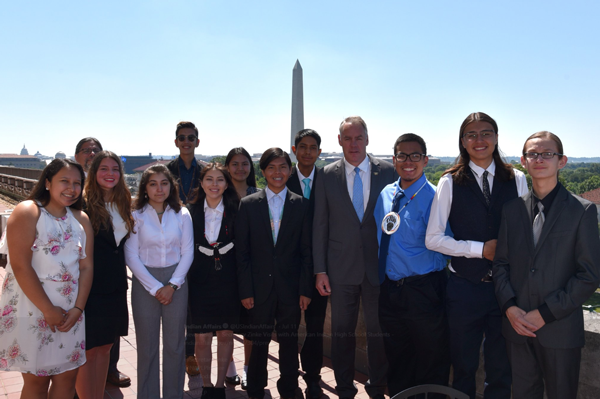
WASHINGTON – Yesterday, U.S. Secretary of the Interior Ryan Zinke and Principal Deputy Secretary for Indian Affairs John Tahsuda met with a group of high school students from across Indian Country. The students are in Washington, D.C., with George Washington University's INSPIRE Pre-College Program which is an abridged version of the school's Native American Political Leadership Program, a semester-long internship program for college and graduate students.
“It was great to meet the next generation of leaders for Indian Country and our nation as a whole,” said Secretary Zinke. “These kids are the brightest of the bright. I look forward to seeing one of them sitting at the Secretary’s desk one day.”
The students visited with the Secretary for about half an hour. They candidly asked questions about important issues relating to the Land Buy-Back Program for Tribal Nations, increasing access to higher education, and cutting red tape. One young man shared that he had family at the Fort Peck Reservation where Secretary Zinke is an adopted member, and that he had heard stories of Secretary Zinke from back home.
Principal Deputy Assistant Secretary for Indian Affairs John Tahsuda met in a separate meeting with the INSPIRE students. He enjoyed their insightful questions and the open discussion.
“It is important for aspiring students to find support when they pursue their interests. I am honored to take part in their education,” said Tahsuda. “I am made hopeful for the future of public service, especially in Indian Affairs, when young minds take such an interest in the field as a career. Young Native leaders who embark on the path to higher education and dedicated public service in Indian Country inspires us all.”
The students in the program identified themselves as members of the following Tribes: Menominee Indian Tribe, The Navajo Nation, Confederated Tribes of Siletz Indians, Choctaw Nation of Oklahoma, Mississippi Band of Choctaw Indians, Hopi Tribe, Nez Perce Tribe, Eastern Band of Cherokee, Seminole Nation, and Athabascan.
For Immediate Release: July 11, 2018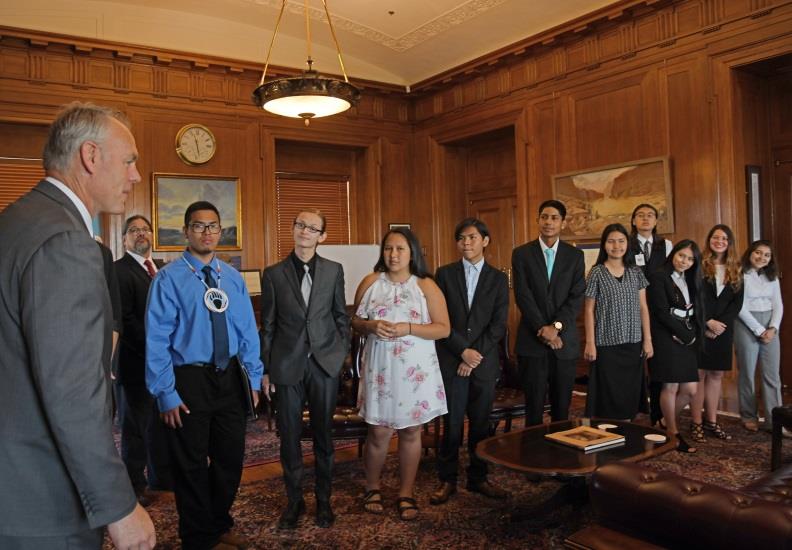

indianaffairs.gov
An official website of the U.S. Department of the Interior
Looking for U.S. government information and services?
Visit USA.gov