


<p>Office of Public Affairs</p>
Official websites use .gov
A .gov website belongs to an official government organization in the United States.
Secure .gov websites use HTTPS
A lock
()
or https:// means you’ve safely connected to the .gov website. Share sensitive information only on official, secure websites.
OPA
 Indian Affairs - Office of Public Affairs
WASHINGTON – Interior Secretary Gale Norton and Acting Assistant Secretary – Indian Affairs Aurene M. Martin will join students, parents, and tribal officials on August 28, 2003, to celebrate the opening of Baca/Dlo’ay azhi Community School, a new Bureau of Indian Affairs (BIA)-operated day school located in Prewitt, N.M.
Baca/Dlo’ay azhi Community School is a K-6 school that will serve approximately 390 day students from the Prewitt and Thoreau communities on the Navajo Nation reservation. The school replaces two existing facilities, Baca Day and Thoreau Boarding Schools, which are on the list of aging BIA schools slated for replacement.
The BIA school system is comprised of 185 elementary and secondary day and boarding schools located on or near 63 reservations in 23 states. In School Year 2001-2002, BIA-funded schools served approximately 48,000 students.
|
WHO: |
Gale Norton, Secretary, Department of the Interior Aurene M. Martin, Acting Assistant Secretary – Indian Affairs, DOI |
|
WHAT: |
Norton and Martin will visit the Navajo Reservation in northwestern New Mexico to celebrate the opening of the Baca/Dlo’ay azhi Community School, where they will meet with students, parents, school representatives and tribal officials. |
|
WHEN: |
Thursday, August 28, 2003 at 10:00 a.m. (all times are local time) 10:00 a.m.–10:40 a.m.: Dedication ceremony (open to press) • Jacque Mangham, Master of Ceremonies and Principal, Baca/Dlo’ay azhi Community School • Posting of Colors by Wingate High School ROTC Honor Guard • Performance by Baca School Indian Club student members • Speakers will include (in order of presentation): • Sarah Begay, President, Baca/Dlo’ay azhi Community School Board • The Honorable Joe Shirley, Jr., President, The Navajo Nation • Boyd Robinson, Supervisory Civil Engineer, Office of Facilities Management and Construction, Bureau of Indian Affairs • Col. Joseph Schroedel, Commander, South Pacific Division, U.S. Army Corps of Engineers • Aurene M Martin, Acting Assistant Secretary – Indian Affairs, Department of the Interior • The Honorable Gale Norton, Secretary, Department of the Interior 10:45 a.m.-11:00 a.m.: Tour of Baca/Dlo’ay azhi Community School (open to press) 11:20 a.m.-11:45 a.m.: Media availability (open to press) 11:45 a.m.-12:30 p.m.: Lunch with students and faculty (open to press) |
|
WHERE: |
Baca/Dlo’ay azhi Community School Directions from Albuquerque, N.M., or Gallup, N.M.: Take Exit 63 off of I-40 (exit is 11 miles East of Thoreau and 19 miles West of Grants, N.M.). When exiting, go North to Hwy. 66 (approximately one-quarter mile). School will be on the left (school is adjacent to I-40). |
CREDENTIALS: Press registration will be provided. Please bring your sanctioned media credentials and if possible, wear on your shirt collar or around your neck for easy viewing. This will assist our staff. Press seating will be provided.
-DOI-
Indian Affairs - Office of Public Affairs
WASHINGTON – Principal Deputy Assistant Secretary – Indian Affairs Aurene M. Martin today announced that the Saginaw Chippewa Tribal College (SCTC) in Mt. Pleasant, Mich., and the Tohono O’odham Community College (TOCC) in Sells, Ariz., have been deemed eligible for assistance under the Tribally Controlled Community College Assistance Act of 1978 (P.L. 95- 471). Under the Act, the Secretary of the Interior has authority to make grants to tribally-controlled colleges or universities for the purpose of continued and expanded educational opportunities for Indian students. Both tribal colleges have been granted initial candidacy for accreditation from the Higher Learning Commission of the North Central Association of Colleges and Schools, one of six regional institutional accrediting associations in the United States.
“I congratulate Saginaw Chippewa Tribal College and Tohono O’odham Community College for the tremendous progress they have made since their founding,” Martin said. “These institutions are valued members of the higher education community and will be welcome additions to the family of BIA-funded tribal colleges.”
Chartered by the Saginaw Chippewa Indian Tribe of Michigan in 1998 as a two-year institution, SCTC provides academic, occupational, vocational, cultural and lifelong learning programs in an environment that emphasizes Ojibwa culture to tribal members, students from other tribes and the general public. The college offers Associate of Arts degrees in General Studies, Native American Studies and Business.
TOCC was chartered by the Tohono O’odham Tribal Nation in 1998 to strengthen the Tohono O’odham people and enhance their culture, values, traditions and way of life through higher education. Under a reciprocal agreement with the Pima Community College District, TOCC students are dually enrolled at both schools in order to earn approved college credit that meets all accreditation standards and to become eligible for financial assistance. TOCC is a two-year institution offering undergraduate degrees in general studies, social services, early childhood education and child development, administrative and office support, computer systems, business and building and construction technologies.
The BIA currently funds 25 tribally-controlled colleges and universities across the country and directly operates two post-secondary institutions of higher learning: Haskell Indian Nations University (HINU) in Lawrence, Kan., and the Southwestern Indian Polytechnic Institute (SIPI) in Albuquerque, N.M. The Bureau also offers financial assistance to Indian undergraduate and graduate students through tribal scholarship programs and the American Indian Graduate Center (AIGC).
The Assistant Secretary - Indian Affairs has responsibility for fulfilling the Department’s trust responsibilities to individual and tribal trust beneficiaries, as well as promoting the self-determination and economic well-being of the nation’s 562 federally recognized American Indian and Alaska Native tribes. The Assistant Secretary also oversees the Bureau of Indian Affairs, which is responsible for providing education and social services to approximately 1.4 million individual American Indians and Alaska Natives from the federally recognized tribes.
Indian Affairs - Office of Public Affairs
WASHINGTON – James E. Cason, Associate Deputy Secretary announces today that Grayford Payne, Chief Financial Officer (CFO) for Indian Affairs was one of fifteen individuals to receive the 2005 Secretary’s Executive Leadership Award at a ceremony held today at the Department of the Interior.
Presenting the awards at the ceremony was Acting Secretary of the Interior Lynn Scarlet. “Your leadership at the Department of the Interior and throughout your public service has helped all of us to accomplish so much more on behalf of the American public than had we not been blessed by your service,” said the Secretary. Prior to becoming the Chief Financial Officer, Mr. Gray served as the Deputy Chief Financial Officer as well as the Director of Financial Management within Indian Affairs.
“Grayford Payne is a fine example of the type of employees we have at Indian Affairs,” said James E. Cason. “His experience and expertise are valuable assets, to our efforts to bring quality services to Indian country and the American people.”
He came to Indian Affairs in 2001, and under his leadership Indian Affairs successfully implemented an Activity Based Cost/Management System. As Indian Affairs Deputy Chief Financial Officer and now CFO Gray has worked to reorganized Indian Affairs CFO operations to improve its financial management and financial accountability. Gray started his career with the Department of Defense, Naval Audit Service providing oversight of Navy National Security programs. From 1993 to 2000 Gray was the Director of Financial Management at the Federal Energy Regulatory Commission where he received the Commission's award for Leadership Excellence for his leadership in transforming the Commission's Office of Financial Management into an effective and efficient CFO organization.
Gray is from Annandale, Virginia and a 1980 graduate of George Mason University with a degree in Accounting. He graduated in 1991 from the Department of Defense - Defense Systems Management College as a certified DOD Program Manager.
The Secretary’s Executive Leadership Awards were created to recognize extraordinary performance and excellence in leadership. The criteria include extraordinary accomplishment of the performance elements in the Senior Executive Service (SES) member’s annual performance agreement and demonstration of excellence in the five Executive Core Qualifications.
--DOI--
Indian Affairs - Office of Public Affairs
WASHINGTON – Bureau of Indian Affairs Director W. Patrick Ragsdale today announced that Allen J. Anspach, acting Regional Director of the Bureau of Indian Affairs (BIA) Western Regional Office in Phoenix, Ariz., has been confirmed in that position effective May 23. Anspach, a member of the Blackfeet Tribe of Montana and a certified Senior Executive Service (SES) administrator, had served in an acting capacity since January 2006. The Western Regional Office serves the federally recognized tribes located in Arizona (except the Navajo Nation), Nevada and Utah.
“Allen Anspach is a solid Bureau of Indian Affairs manager who brings 28 years of tribal relations and policy experience to his new post,” Ragsdale said. “I am pleased that he has joined our regional senior management team.”
Anspach’s federal career began in 1978 when he joined the BIA’s Phoenix Area Office (now Western Regional Office) as a tribal operations officer intern, a position he held until 1981 when he became a tribal operations specialist. He served in the Phoenix Area Office until 1985 during which time he spent 10 months during the years 1982 to 1983 at the Interior Department headquarters in Washington, D.C., as a trainee in its Departmental Management Development Program. His training assignment included helping to develop, as a member of the Assistant Secretary – Indian Affairs staff, President Reagan’s Indian policy and a stint at the Senate Committee on Indian Affairs.
After his training assignment, Anspach returned to the Bureau where, in January 1985, he was appointed superintendent of its Pawnee Agency, which services the Kaw Nation, the Otoe Missouria Tribe, the Pawnee Nation, the Ponca Tribe, and the Tonkawa Tribe who live in north central Oklahoma. He went on to serve as superintendent at three BIA agencies in Arizona: the San Carlos Agency on the San Carlos Apache Indian Reservation (appointed November 1988); the Colorado River Agency on the Colorado River Indian Reservation (appointed June 1993); and the Fort Apache Agency on the White Mountain Apache Indian Reservation (appointed September 2005).
“I am honored to have been given this tremendous opportunity to serve the tribes in the Western Region,” Anspach said. “I look forward to continuing our efforts to support tribal self-determination and economic prosperity.” Anspach received a bachelor of science degree from the University of Arizona-Tucson in 1975. While attending UA he worked as a seasonal wildland firefighter, helitack crew member and helitack foreman at the San Carlos Agency. After graduation, he taught vocational agriculture on the Navajo Nation Reservation at Ganado High School in Ganado, Ariz., and on the Tohono O’odham Nation Reservation at Baboquivari High School in Sells, Ariz. Note to Editors: The photograph of Allen J. Anspach that accompanies this release may be viewed at www.doi.gov.
Indian Affairs - Office of Public Affairs
WASHINGTON – Acting Deputy Assistant Secretary for Policy and Economic Development – Indian Affairs George T. Skibine today congratulated the Oglala Sioux Tribe and the State of South Dakota on signing a memorandum of understanding to establish a joint sovereign filing system to administer the tribe’s newly adopted secured transactions commercial code. He was represented by officials of the Office of Indian Energy and Economic Development at a signing ceremony held yesterday on the Pine Ridge Indian Reservation in South Dakota. IEED Division of Economic Development Director Jack Stevens and DED Policy Analyst Victor Christiansen were among other federal, tribal and state officials who gathered July 30 at the reservation’s Suann Big Crow Boys and Girls Club to witness the historic event. The tribe received funding from the IEED to develop its code.
“I want to congratulate the leadership of the Oglala Sioux Tribe and the State of South Dakota for their vision of promoting economic development in Indian Country,” Skibine said. “By adopting a secured transactions commercial code, the Tribe has taken a major step in addressing the credit needs of businesses and consumers on the Pine Ridge Reservation. Their partnership with the State of South Dakota is a model that other tribes and states can embrace.”
Tribal secured transactions commercial codes enable tribal businesses and individuals residing on federal Indian trust lands to obtain credit for making off-reservation purchases, such as cars, appliances and other durable goods, by allowing sellers to enforce liens or security interests in such items after they have been transported onto a reservation.
The Joint Sovereign MOU was signed by OST President John Yellow Bird Steele and South Dakota Secretary of State Chris Nelson with members of the Oglala Sioux Tribal Council present. In addition to Stevens, speakers included Ellie Wicks, Constituent Services Representative for U.S. Senator Tim Johnson, Jesse Ewing, Constituent Services Representative for U.S. Senator John Thune, Rick Hanson, Constituent Services Representative for U.S. Representative Stephanie Herseth Sandlin and Jacqueline G. King, Assistant Vice President and Community Affairs Officer with the Federal Reserve Bank of Minneapolis.
The OST is one of ten federally recognized tribes in six states funded by the IEED to develop tribal secured transactions commercial codes. The others are: the Blackfeet Tribe, the Crow Nation and the Chippewa-Cree Tribe in Montana, the Sac and Fox Nation and the Seminole Nation in Oklahoma, the Confederated Tribes of the Umatilla Indian Reservation and the Confederated Tribes of the Warm Springs Reservation in Oregon, the Tulalip Tribes in Washington State and the Shoshone and Arapaho Tribes of the Wind River Reservation in Wyoming.
The Secretary of the Interior created the Office of Indian Energy and Economic Development to encourage economic development in Indian Country. The IEED’s mission is to foster strong Indian communities by creating jobs, Indian-owned businesses, and a trained workforce, and by developing Indian energy and mineral resources, and increasing access to capital. The IEED believes that thriving economies and opportunities for work are the best solutions to Indian Country’s economic and social challenges.
-DOI-
Indian Affairs - Office of Public Affairs
WASHINGTON – Acting Deputy Assistant Secretary for Policy and Economic Development – Indian Affairs George T. Skibine today offered praise for the installation and activation of the first large-scale wind turbine to be located on the Pine Ridge Indian Reservation in South Dakota. The turbine, which is owned by radio station KILI-FM and was funded in part by the Office of Indian Energy and Economic Development, was activated at a noontime ceremony yesterday in Porcupine, S.D. Skibine was represented at the July 31 event by IEED Division of Economic Development Director Jack Stevens and DED Policy Analyst Victor Christiansen.
“The KILI radio station plays a vital role on the Pine Ridge reservation as a news and information provider,” Skibine said. “With the electric power and revenue potential this wind turbine offers, KILI will continue to serve its community, and Indian Country, as ‘The Voice of the Lakota Nation.’ I am proud that we have helped to make the KILI wind turbine a reality.”
The Pine Ridge reservation is home to the 42,357-member Oglala Sioux Tribe and is located in an area of the United States with wind speeds in excess of 18 miles per hour. Great Plains wind power is estimated to have the potential for generating 535 billion kilowatt-hours per year – in comparison, the total U.S. electric generation in 2004 was 3,853 billion kWh – yet much of the region’s wind power has remained undeveloped. The 72-foot high, 65-kilowatt wind turbine will power KILI, which is celebrating its 25th anniversary this year, and generate revenue for the station through the sale of surplus electricity to back to the grid.
The IEED provided the final $50,000 towards the turbine’s purchase and installation price of $150,000. Given the radio station’s importance as an economic hub for both the Pine Ridge and neighboring Rosebud Sioux reservations, the IEED also provided $106,000 for a program to train OST and Rosebud Sioux tribal members in wind turbine installation, repair and maintenance. The KILI wind turbine is expected to produce 92,000 kWh of power per year with an estimated savings to the station in utility costs of $12,000 per year.
In addition to Stevens and Christiansen, attendees included John Yellow Bird Steel, President of the Oglala Sioux Tribe and members of the Oglala Sioux Tribal Council, Melanie Janise, KILI Station Manager, Ellie Wicks, Constituent Services Representative for U.S. Senator Tim Johnson, Jesse Ewing, Constituent Services Representative for U.S. Senator John Thune, Pat Spears, President of the Intertribal Council on Utility Policy (ICOUP) and Saye Brown of Honor the Earth. The Secretary of the Interior created the Office of Indian Energy and Economic Development to encourage economic development in Indian Country. The IEED’s mission is to foster strong Indian communities by creating jobs, Indian-owned businesses, and a trained workforce, and by developing Indian energy and mineral resources, and increasing access to capital. The IEED believes that thriving economies and opportunities for work are the best solutions to Indian Country’s economic and social challenges.
-DOI-
Indian Affairs - Office of Public Affairs
WASHINGTON - Acting Deputy Assistant Secretary for Policy and Economic Development - Indian Affairs George T. Skibine today announced that the Office of Indian Affairs and the Bureau of Indian Affairs (BIA) have been fully reconnected to the Internet. The Office of the Chief Information Officer – Indian Affairs (OCIO-IA) has successfully reconnected 5,000 computer users in 148 Indian Affairs locations across the country. This accomplishment occurred one month ahead of schedule.
“I want to thank the public and the tribes for their patience during the time we have been offline,” Skibine said. “Internet connectivity will enable Indian Affairs employees to use web technologies to improve business processes and customer interactions for better and more efficient communications with those we serve.”
On December 5, 2001, the federal judge in a class action lawsuit, Cobell, et al., v. Secretary of the Interior, et al., entered a temporary restraining order requiring the Department to disconnect from the Internet all information technology systems that housed or provided access to individual Indian trust data on the basis of perceived risks to that data. On December 17, 2001, a Consent Order was entered that continued the prohibition and established a process for the Department to obtain permission from the court to reconnect affected bureaus on a case-by-case basis.
Parts of the Department were permitted to reconnect in 2002. However, the five offices that work closely with Indian trust data remained off the Internet. On May 14, 2008, U.S. District Judge James Robertson, the presiding judge in the case, vacated the Consent Order thus allowing those offices to reconnect. On May 23, 2008, BIA offices in the Washington, D.C., metropolitan area were connected followed by offices in Albuquerque, N.M., on June 24, 2008. As of July 28, all BIA regional offices, agencies, and field offices still off-line were connected.
“I am extremely proud of how the Indian Affairs organization effectively collaborated to accomplish this historic milestone in record time through proven program management and information technology best practices,” said Indian Affairs CIO Sanjeev Bhagowalia. “We must continue to follow the policies and procedures that have been established as we use the Internet to better serve and communicate with Indian Country. We have instituted policies and mandatory training so that everyone is aware of each employee’s role in ensuring the security of Indian Affairs’ systems.”
Indian Affairs is responsible for fulfilling the Interior Department’s trust responsibilities to individual Indian and tribal trust beneficiaries, as well as promoting tribal self-determination, self-governance and economic development for the nation’s 562 federally recognized American Indian and Alaska Native tribes and their 1.9 million members.
-DOI-
Indian Affairs - Office of Public Affairs
WASHINGTON – Bureau of Indian Affairs Director Jerold L. “Jerry” Gidner today announced that he has named Michael S. Black as Regional Director of the BIA’s Great Plains Regional Office in Aberdeen, S.D. His appointment became effective on July 20. The Great Plains Regional Office oversees 12 BIA agencies serving the 16 federally recognized tribes located in the states of Nebraska, North Dakota and South Dakota.
“I am pleased that Mike Black has joined the ranks of Bureau of Indian Affairs senior regional executives,” Gidner said. “His years of experience working with BIA field staff, tribal governments, and other federal and state agencies will make him a great addition to my team.”
Black, an enrolled member of the Oglala Sioux Tribe, had been serving as the Deputy Regional Director – Indian Services in the BIA’s Rocky Mountain Regional Office in Billings, Mont., since January 2004. He also had served eight months as the acting Great Plains Regional Director starting in June 2007.
Black began his federal career in 1987 in the BIA’s Aberdeen Area Office (now the Great Plains Regional Office) as a General Engineer with the Branch of Facilities Management. From 1992 to 2001, he worked in the BIA’s Billings Area Office (now the Rocky Mountain Regional Office) as Regional Facility Manager, where he provided management and oversight of the Bureau’s facilities construction and operations and maintenance programs. In December 2001, he was named Chief of the Division of Engineering, where he was responsible for regional facility management, road construction, and road maintenance and safety programs.
As the Rocky Mountain deputy regional director, Black was responsible for providing management and oversight for all Indian Services programs including Road Construction, Road Michael Black Named Regional Director – Maintenance, Tribal Government Services, Credit, Housing, Self-Determination, Social Services, Safety, and Environmental and Cultural Resources Management.
Black graduated from Aberdeen Central High School in 1982. He received a B.S. degree in Mechanical Engineering from the South Dakota School of Mines & Technology in 1986.
Note to Editors: A photo of Michael S. Black may be viewed via the Interior Department’s website at www.doi.gov.
-DOI-
For Immediate Release: September 5, 2008 Indian Affairs - Office of Public Affairs
WASHINGTON – In June and July 2019, the Land Buy-Back Program for Tribal Nations mailed more than $140 million in purchase offers to more than 18,000 owners of fractional land interests at the Navajo Nation. The deadline for landowners to return their voluntary purchase offers is either August 30, 2019, or September 30, 2019, depending on the offer cover letter date.
Due to the large number of fractional land interests at the Navajo Nation, the Buy-Back Program sent purchase offers to landowners in two different mailing waves. The two mailing waves are based on various land areas across the Navajo Reservation. Individuals may own, and receive offers for, interests in land in multiple land areas.
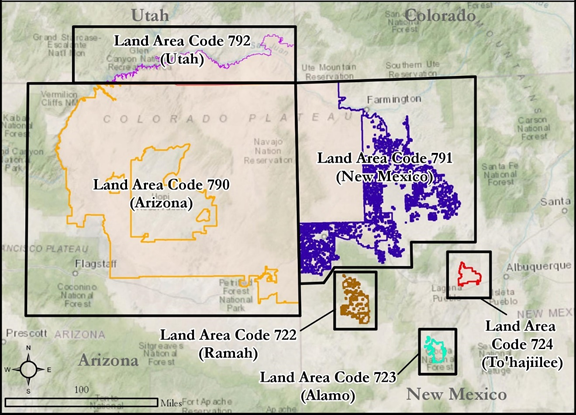
Wave 1. The first wave of offers is for interests in certain lands in New Mexico with a corresponding land area code (LAC) of 791. These offers have a cover letter date of July 1, 2019. Landowners with fractional interests in LAC 791 have until August 30, 2019, to consider and return accepted offers in the pre-paid postage envelopes provided.
Wave 2. The second wave of offers has a cover letter date of August 1, 2019, and was sent to Navajo Nation landowners for interests at the following LACs: 722 (Ramah), 723 (Alamo), 724 (To’hajiilee), 790 (Arizona), and 792 (Utah). Landowners who received offers for interests owned in one or more of these five LACs have until September 30, 2019, to consider and return accepted offers in the pre-paid postage envelopes provided.
“We are proud of the initial Buy-Back Program implementation at the Navajo Nation. The Program achieved significant results and transferred more than 155,000 equivalent acres of land to the Navajo Nation,” said Principal Deputy Special Trustee Jerry Gidner. “We must continue our government-to-government collaboration to make the current round of implementation a success, while also ensuring that landowners understand their options, and have access to the information they need for an informed decision.”
Various informational tools are available to landowners, who are encouraged to think strategically about their options and carefully consider how to use the funds they receive from selling their land. The Program’s website includes detailed frequently asked questions, a schedule of upcoming outreach events, and additional information to help individuals make informed decisions about their land.
Landowners are encouraged to call the Trust Beneficiary Call Center (Call Center) at 888-678-6836 or visit their local Office of the Special Trustee for American Indians (OST) office to ensure that their address on file is current, ask questions about their land or purchase offers, and request a copy of the appraisal completed for their land.
Addresses Needed for Some Landowners. Nearly 1,700 Navajo Nation landowners do not currently have an up-to-date address on file with OST and, thus, the Program cannot mail them an offer package. To receive an offer package in the mail, landowners must contact the Call Center or OST by the following dates:
- August 23, 2019: landowners with interests in LAC 791; and
- September 23, 2019: landowners with interests in LACs 722, 723, 724, 790, and 792.
Overall Program Progress. The Buy-Back Program implements the land consolidation component of the Cobell Settlement, which provided $1.9 billion to consolidate fractional interests in trust or restricted land within a 10-year period set to expire in November 2022. As of 8/20, approximately $285 million remain, comprised of $156 million in the land purchase portion of the fund and $129 million in the implementation portion of the fund.
Since the Program began making offers in December 2013, more than 874,400 fractional interests have been transferred to tribal governments, which represents 35 percent of the total fractional interests in 2013 at the 52 locations where Program implementation has occurred and the equivalent of 2.5 million acres of land. As a result of the Buy-Back Program, tribal ownership now exceeds 50 percent in 17,300 more tracts of land (representing an increase of more than 142 percent for the locations where implementation has occurred), facilitating the exercise of tribal sovereignty and self-determination.
Interests consolidated through the Buy-Back Program are restored to tribal trust ownership. Returning fractionated lands to tribes in trust has the potential to improve tribal community resources by increasing home site locations, improving transportation routes, spurring economic development, easing approval for infrastructure and community projects, and preserving traditional cultural or ceremonial sites.
The 2019 appropriations process realigned the Land Buy-Back Program from the Office of the Secretary to OST. The realignment of the Buy-Back Program institutionalizes best practices to fulfill the Department’s fiduciary duties. Further, it strengthens coordination efforts and opportunities to streamline processes.
# # #
For Immediate Release: August 21, 2019
 Indian Affairs - Office of Public Affairs
Acting Assistant Secretary-Indian Affairs Michael J. Anderson today announced that effective today Loretta Tuell, Director of Interior’s Office of American Indian Trust (OAIT), has been designated the Acting Deputy Assistant Secretary – Indian Affairs until the end of the Clinton Administration. She will also continue as OAIT director where she is responsible for advising the Secretary and the Assistant Secretary – Indian Affairs on decisions, actions, and procedures relating to the Department’s trust responsibilities affecting American Indian trust assets. Ms. Tuell, member of the Nez Perce Tribe and a native of Lapwai, Idaho, has been with the Department since February 1998 when she arrived to serve as Special Assistant and Counselor to the Assistant Secretary. In June 1998, she was named Acting Director for the Office of Tribal Services within the Bureau of Indian Affairs (BIA). Prior to joining Interior, she served as Counsel to Senator Daniel K. Inouye (D-HI) on the Senate Indian Affairs Committee from 1993 to February 1998.
Ms. Tuell has a Bachelor of Arts degree in Political Science-Public Administration from the Washington State University-Pullman (1988) and a Juris Doctorate degree from the University of California-Los Angeles (1992). She later became a senior law clerk for the Los Angeles County District Attorney’s Office in California. Ms. Tuell has served on the board of the National Native American Bar Association and as a Special Trustee for the Board of UNITY (United National Indian Tribal Youth). She is a member of the State Bar of California.
-BIA-
For Immediate Release: January 16, 2001

indianaffairs.gov
An official website of the U.S. Department of the Interior
Looking for U.S. government information and services?
Visit USA.gov