


<p>Office of Public Affairs</p>
Official websites use .gov
A .gov website belongs to an official government organization in the United States.
Secure .gov websites use HTTPS
A lock
()
or https:// means you’ve safely connected to the .gov website. Share sensitive information only on official, secure websites.
OPA
 Indian Affairs - Office of Public Affairs
The Bureau of Indian Affairs has announced a series of hearings throughout Indian country on its proposed plans to close all but three of its off-reservation boarding schools. Notice of the hearings is being published in the Federal Register, Interior Assistant Secretary Ken Smith said today.
Schools slated to be closed at the end of this school year are the Wahpeton Indian School in North Dakota; Concho Indian School in Oklahoma; and the Southwestern Indian Polytechnic Institute (SIPI) in New Mexico. The phase-out plans for the closure of the Intermountain School, Utah and Mt. Edgecumbe in Alaska at the end of the 1982-83 school year; Sequoyah Indian School, Oklahoma and Flandreau in South Dakota at the end of the 1983-84 year; and the Phoenix Indian School at the end of the 1984-85 school year.
The three schools to be continued would be Chemawa, Oregon, Sherman, California and Riverside, Oklahoma.
The first hearings would be March 30 at Anchorage, Alaska and Albuquerque, New Mexico. Others will be April 1 at Sitka, Alaska and Phoenix, Arizona; April 6 at Oklahoma City, Oklahoma; April 13 at Minneapolis, Minnesota and Portland, Oregon; and April 15 at Billings, Montana and Aberdeen, South Dakota.
The hearings will begin at 10 a.m. at each site. For the exact location or additional information please call the local BIA area office or Ms. Carmen Taylor at 202/343-4493.
Persons wishing to file written testimony should send it no later than April 16th to the Director of Indian Education Programs, BIA, 18th and C Sts., N.W., Washington, D. C. 20240.
Indian Affairs - Office of Public Affairs
The Bureau of Indian Affairs has published an updated report on American Indian reservations populations. The booklet includes estimates on unemployment.
Dated December, 1981, the report shows a population of 734,895 living on or near Indian reservations, including former reservations in Oklahoma. It also includes 64,047 Eskimos, Aleuts and Indians in Alaska.
The reservation population, which constitutes the BIA's service population, is 52 percent of the 1.4 million total Indian population counted in the 1980 census.
Unemployment on the reservations is reported to be 31 percent of the labor force.
The information in the report is presented by states, BIA area offices, agencies and individual reservations.
The data was compiled from information provided by BIA field offices.
The BIA's last report on reservation populations, in 1979, showed a total of 681,213 with a 27 percent unemployment rate.
Indian Affairs - Office of Public Affairs
A proposed project to develop oil and gas resources within the boundaries of the Miccosukee Indian Reservation in Florida would not create significant environmental issues or concerns, the Bureau of Indian Affairs (BIA) has concluded.
The BIA has prepared an environmental assessment on a proposal by Natural Resource Management Corporation, Tesoro Petroleum Corporation and American Quasar Petroleum Company to engage in explorations, development and production activity for oil and gas on the reservation.
The proposal calls for a reconnaissance survey over 76,800 acres of the reservation, drilling exploratory wells, the selection of wells for production and the construction of pipelines, tanks, and other facilities.
Potential environmental impacts of the proposal would be typical of those encountered elsewhere in nearby locations in Florida. Potential impacts on land use, wildlife habitats, and air/water qualities are judged to be either absent or insignificant and of short duration.
Single copies of the environmental assessment may be obtained from the BIA Eastern Area Office, 1951 Constitution Avenue, N, W., Washington, D. C. 20245.
Indian Affairs - Office of Public Affairs
The Bureau of Indian Affairs is publishing in the Federal Register proposed revisions in the regulations governing fishing on the Hoopa Valley Indian Reservation in northern California
The most significant change is the ban on gill net fishing during the fall chinook run from 9 a.m. Monday to 5 p.m. Wednesday of each week and from 9 a.m. to 5 p.m. on Thursday and Friday.
In December 1981, Interior Deputy Assistant Secretary, Roy Sampsel, visited the reservation and adjoining areas to discuss with the Indian community the state of the fishery resource. One frequent comment made to Sampsel was that the Indians on the reservations were not asked to participate in the writing of the regulations or their subsequent changes. Subsequently, a pamphlet was developed by a committee of Indian fishermen and distributed to the Indian community containing recommended changes, a copy of the existing regulations, and a questionnaire soliciting Indian comments.
Responses to the questionnaire provided valuable information on public feeling. They indicated that a number of changes needed to be made in the regulations both to make them more effective in conserving the resource and to alleviate unnecessary burdens on the persons governed by the rules.
Comments on the proposed regulations should be sent within 30 days of publication to: Sacramento Area Office, Bureau of Indian Affairs, Federal Building, 2800 Cottage Way, Sacramento, California 95825. For further information, contact Wilson Barber, Superintendent, Northern California Agency, Bureau of Indian Affairs, P.O. Box 367, Hoopa, California 95546, 916/625-4285.
Indian Affairs - Office of Public Affairs
Assistant Secretary of the Interior for Indian Affairs Ken Smith today announced a reorganization of the BIA's administrative structure that will create a $16 mi ion annual saving and "move the Indian agency a long way toward its goal of making as much of its budget as possible available for funding of programs at the reservation level."
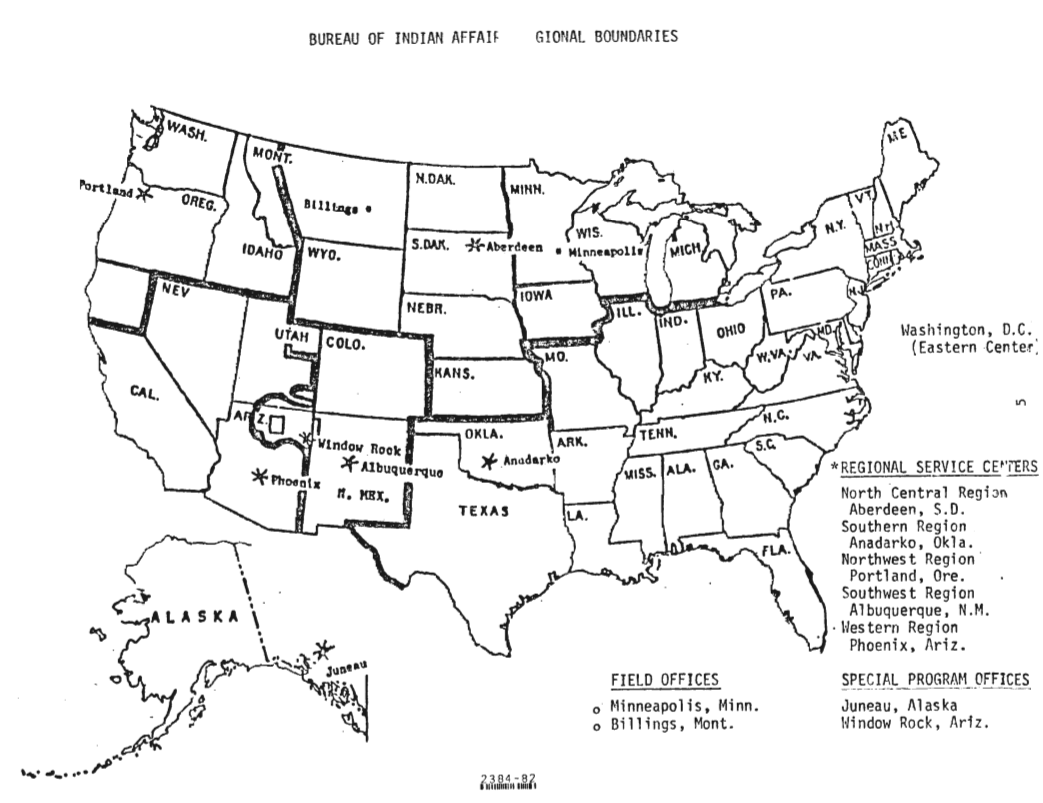
The reorganization consolidates the BIA's 12 area offices into five regional service centers located at Albuquerque, New Mexico; Anadarko, Oklahoma; Aberdeen, South Dakota; Phoenix, Arizona; and Portland, Oregon.
In addition, special program offices at Juneau, Alaska, and Window Rock Arizona, will serve the state of Alaska and the Navajo Reservation. These special offices will report directly to the BIA central office in Washington D.C., and not be under the jurisdiction of any regional center.
There will be field offices, reporting to the Aberdeen Center, at Billings Montana, and Minneapolis, Minnesota.
The plan also reduces BIA's 12 area education offices to five regional centers -- located at the regional service centers -- and two special program education offices, located with the special program offices.
Smith said the reorganization of the Bureau is designed to reduce the cost of administering the Bureau's field programs; to restructure the field offices to provide improved technical service capability; and to improve the efficiency of implementing Bureau programs and services.
The regional service centers and the areas they will serve are: Southwest Center, Albuquerque, New Mexico: New Mexico, Colorado and western Utah.
Southern Center Anadarko, Oklahoma: Oklahoma.
Western Center, Phoenix, Arizona: Arizona, Nevada, southern Utah, and southern and central California.
Northwest Center, Portland, Oregon: Washington, Oregon, Idaho, the northern parts of California, western Montana, and the Metlakatla Reservation in southern Alaska.
North Central Center, Aberdeen, South Dakota: Eastern Montana, Wyoming, North and South Dakota, Nebraska, Minnesota, Wisconsin, Michigan, Iowa and Kansas.
For programmatic purposes, those tribes formerly in the Eastern Area Office will be served from a technical assistance and service office in Washington, D.C., reporting to the Deputy Assistant Secretary for Operations. Eastern area office states include New York, Maine, Florida, Louisiana, North Carolina and Mississippi. For administrative purposes, such as computer services, the tribes in those states will be served by the Southern center.
Smith said the final number and selection of sites for the regional service centers came after he and his immediate staff and regional officials held extensive consultations with the tribes and after the work of task forces in each region had been studied and analyzed.
Smith said consultation with the approximately 500 tribal governments served by the Bureau was conducted by senior executive personnel appointed as provisional regional directors of the proposed offices. 11 In addition, the Bureau received about 275 written comments during that period from tribes, inter-tribal councils, members of Congress and interested individuals," he added. ·
The major changes from the proposed plan revealed in February are:
(1) elimination of the proposed Northeast regional service center through consolidation of the area previously served by the Minneapolis area office with the North Central region, and the administrative consolidation of the area previously served by the Eastern area office with the Southern region; {2) location of the North Central regional office in Aberdeen, rather than Rapid City; and (3) location of the Southern regional office in Anadarko, rather than Oklahoma City.
"There are a number of compelling reasons for the actions being taken to realign the Bureau's middle management structure," Smith said.
"Foremost is the impact of Public Law 93-638, the Indian Self-Determination Act, which has encouraged and strengthened tribal government participation in designing and contracting for the delivery of program services to the tribes," he said.
About 25 percent of the operation of Indian programs was performed under self-determination contracts by FY 1981. Smith said that percentage will continue to increase.
"The enactment of Public Law 95-561, the Indian Education Act, continued the emphasis on Indian involvement by creating school boards and implementing a system of employing teachers through contracts rather than as direct Bureau staff," he added.
In school year 1981-82, almost 2,000 out of a total of 7,400 Bureau educators were employed under this system.
"We expect the number of contract teachers to increase by as much as 1,000 in the 1982-83 school year," Smith said.
A third reason noted by Smith was Public Law 92-203, the Alaska Native Claims Settlement Act, which is limiting the Bureau's responsibility for Alaska programs.
"For example," Smith said, "Certain programs in Alaska such as general assistance and education have been or are projected to be delivered in the future by the State."
The Bureau also anticipates a ·continued increase in various BIA programs contracted to Native villages and organizations.
Smith said the total numbers of employees to be in each of the locations are still indeterminate. Final decisions will be made on the staffing patterns needed to fulfill the responsibilities the BIA has at each service center as implementation plans go forward. "But we are confident that the reduction in total Federal employees in the area and central offices will be 372 as we originally planned," he added.
"This is my response to the request that I have heard repeatedly from tribal leaders throughout my travels in Indian Country to reduce the overhead costs of operating the Bureau," Smith said. Estimates of the onetime costs of carrying out the reorganization are in the neighborhood of $7 million.
In the realignment of the Bureau's education offices, the regional education centers and the Navajo special program office will be headed by an assistant director for education with line authority and responsibility for education activities in the regions. Assistant director positions were formerly located in the central office.
"The plan complies with the mandates of Public Law 95-561 which stresses local community control of Indian schools under professional educators," Smith pointed out.
He said the Bureau is now preparing detailed organizational changes in accordance with Department procedures and anticipates transfer of authorities from the area office structure to the regional organization structure by October 1, 1982.
"Final close down of the existing area offices and disposition of files, records, associated office equipment, etc., is expected to be completed prior to October 1, 1983," Smith said.
The regional implementation is phased to overlap the phase out of current area structure so that day-to-day business continues effectively, and service to tribes is not impaired by the realignment process.
Smith said that budget reprogramming authority has been requested from appropriate committees in Congress in order to carry out the reorganization prior to the beginning of FY 1983.
For Immediate Release: May 28, 1982
 Indian Affairs - Office of Public Affairs
Alaskan land selections by Alaska Native corporations which exceed the acreage to which corporations are entitled may be reduced through procedures proposed in the Federal Register by the Department of the Interior.
Native corporations, entitled to a total of 44 million acres of land under the Alaska Native Claims Settlement Act of 1971, applied for more acreage than they are entitled to receive during the early 1970s when the Act required them to select lands for possible conveyance.
The Native corporations were allowed to make these over selections to ensure receipt of the full acreage allotted to them. Interior could not ensure conveyance of many of the lands since they were subject of various legal questions. Current regulations allow over selection, but do not specify a maximum amount allowable.
Proposed regulations would set a method for determining what over selection is and a system for reducing it. The regulations would also give the Secretary authority to reject over selections that exceed 125 percent of the acreage to which the corporation is entitled.
Preparation of the regulations was begun as a result of a stipulation agreement between Interior and the State of Alaska Comments on the proposed regulations will be accepted until September 19, 1982 by the Director (140), Bureau of Land Management, Department of the Interior, Washington, D.C. 20240.
Indian Affairs - Office of Public Affairs
The Bureau of Indi an Affairs has officially closed its Office of Technical Assistance and Training (OTAT) at Brigham City, Utah 1 Interior Assistant Secretary Ken Smith announced today.
Smith said the document abolishing OTAT, a unit in the BIA’s central office structure, was signed March 16 and that approximately 72 employees would receive general reduction in force (RIF) notices at an employee meeting to be held today.
Smith said the closing of the office was mandated oy Congress through the Interior appropriations bill which provided funding in fiscal year 1982 only for the continuation of two sub-units of the office and closing expenses.
The sub-units to be continued are the police academy at Brigham City and the Tribal Administrative and Accounting Services, which is located at Littleton, Colorado,
A total of 52 positions are being abolished. The 72 persons, including those on the police academy staff and a separate inspections and evaluation unit at Brigham City who will receive general RIF notices, will compete according to RIF procedures, for about 20 jobs to be continued at Brigham City.
Smith said "every effort will be made to place people who lose jobs in Brigham City in vacancies elsewhere in the Bureau." He said he had exercised waiver provisions in the Indian preference policy for the placement of the non-Indians who would lose jobs.
The Continental Divide Training Center, a sub-unit of OTAT located in western New Mexico, has been transferred to the BIA’s Albuquerque area office. Other OTAT activities will be decentralized and continued through the program offices.
OTAT was established in June of 1979 with the consolidation of various training and technical assistance functions of the BIA at Brigham City.
Indian Affairs - Office of Public Affairs
Although millions of Federal dollars have been spent over the past 20 years on economic development on the Pine Ridge Indian Reservation in South Dakota, the reservation's economy is, at best, only marginally better according to a recently released review conducted by the Interior Department's Inspector General.
Federal funds were used to help develop an industrial park, a plastics factory, an electronics company, a sawmill and other enterprises. At the present time, only one business enterprise of significance is operating, Inspector General Richard Mulberry said, and it is in jeopardy.
The review covered contracts issued between 1977 and 1980 and included the now defunct Oglala Sioux Agriculture Enterprise, which received approximately $2 million from various Federal agencies. The money is gone, Mulberry said, and the remaining equipment has been, or will be, sold to pay portions of defaulted loans. A former Pennsylvania plastic fishing bait company was purchased by the Tribe for $305,000, although, Mulberry said, the Tribe was warned that the company was financially troubled. The review shows that this enterprise lasted about two years and then defaulted on a $195,000 loan guaranteed by the Bureau of Indian Affairs.
Another review conducted by Interior's Inspector General at the Pine Ridge Reservation, on selected programs, contracts and grants of the Oglala Sioux Community College (OSCC), shows that OSCC purchased items of questionable necessity because it had too much money.
Some of the questioned expenditures, Mulberry said, included (1) $48,500 spent for computer equipment, which after 14 months from date of purchase had yet to be used because appropriate software programs had not been developed; and (2) $13,277 spent for a graduation ceremony honoring 17 students. This expenditure, the review shows, included $4,140 for dance contest prizes, $1,678 for food, and $2,417 for gifts and awards to the graduates. In addition, Mulberry said, OSCC implemented a new salary scale in which annual salaries were increased 28 percent over the previous year.
With respect to economic development on the Pine Ridge Reservation, Mulberry said it has been recommended, in part, to the Oglala Sioux Tribal Council that it (1) avoid Tribal ownership, (2) not start something simply because Federal money is available, and (3) require better cost/benefit analysis. It was also recommended, he said, that the Tribal Council take a more assertive role in the financial affairs of the Oglala Sioux Community College, because the Council is the only entity which can balance reservation needs.
Indian Affairs - Office of Public Affairs
The Bureau of Indian Affairs has announced that it is publishing in the Federal Register, April 21, 1982, proposed regulations to govern the preparation of a membership roll of the Pribilof Islands Aleut Communities of St. Paul and St. George. The roll to be prepared will serve as a basis for a per capita distribution of judgment funds awarded to the communities by the U. S. Court of Claims.
Comments on the proposed regulations should be sent within 30 days after publication to the Division of Tribal Government Services, Bureau of Indian Affairs, 1951 Constitution Avenue, N. W., Washington. C. 20245. For additional information, contact Kathleen Slover at the above address, telephone 703/235-8275.
Indian Affairs - Office of Public Affairs
The Crow Tribe of Montana, which received $11.6 million in federal and state contracts and earned $10.9 million from mineral and grazing leases and interest during fiscal years 1980 and 1981, was in a state of technical insolvency as of September 30, 1981, according to Department of the Interior Inspector General Richard Mulberry.
A review recently completed by the Office of Inspector General shows that the Tribe had current liabilities of over $1 .8 million, as well as long term debt of about $6 million, and had no ready means for the liquidation of the current liabilities and long term debt servicing costs. This situation occurred, according to Mulberry, because the Tribe used whatever cash it had on hand to meet payrolls and other expenses regardless of the original purpose of the funds. For example:
- The Tribe owed $455,000 to the Internal Revenue Service, of which the majority represents funds withheld from salaries for income tax and social security.
- The Tribe owed $527,000 to various federal agencies for excess advances or letter of credit drawdowns under contracts that have been completed, cancelled or suspended.
To avoid such problems and provide the basis for sound financial and administrative management, the Tribe, the review shows, has spent about $1 million of federal funds since 1976 for the design and implementation of a management information and accounting system.
The basic controls in the accounting system were not utilized, however, and at times were even ignored or circumvented, Mulberry said. Furthermore, he said, the system was not maintained in a timely and accurate manner. The net effect was that a $1 million management information system was ignored or not maintained in a manner that enabled it to be relied upon for management controls and accurate and timely financial data.
The Tribe's management of the various federal programs has also been inept, Mulberry said. Several programs have been suspended or cancelled because of the program's condition and the lack of progress or failure to adhere to contract requirements.
While it is difficult to pinpoint the causes of the Tribe's problems, Mulberry said, they are due in part to the competence and experience of supervisory personnel and the degree of supervision and training provided by these supervisors. Further, the Tribe's unusual constitution and political processes are cumbersome and contribute to the problems uncovered on the Reservation.
Upon completion of the initial survey work, Mulberry said, the BIA was advised that because of the Tribe's adverse financial condition and programmatic and financial management problems, it would need some type of federal stewardship or control over finances and programs. BIA appointed a federal manager in November 1981. After determining the full extent of the problem, Mulberry further recommended that BIA arrange for the federal manager to control all Tribal and federal funds, develop a plan for the payment of liabilities, provide for the proper maintenance of the financial management system and establish methods to improve program accomplishment.

indianaffairs.gov
An official website of the U.S. Department of the Interior
Looking for U.S. government information and services?
Visit USA.gov