An official website of the United States government

Official websites use .gov
A .gov website belongs to an official government organization in the United States.

Secure .gov websites use HTTPS
A lock () or https:// means you’ve safely connected to the .gov website. Share sensitive information only on official, secure websites.

ASIA Tara Sweeney

Former Assistant Secretary - Indian Affairs Tara Katuk Mac Lean Sweeney

Tara Katuk Mac Lean Sweeney served as the 13th Assistant Secretary – Indian Affairs from July 30, 2018 until January 20, 2021. Ms. Sweeney was confirmed by the United States Senate on June 28, 2018.

Ms. Sweeney is the first Alaska Native and the second woman to be confirmed for the position. She came to the Department of the Interior after serving as executive vice president of external affairs for the Arctic Slope Regional Corporation (ASRC).

BIA Logo Indian Affairs - Office of Public Affairs

First strategic plan released by the Bureau of Indian Education

Media Contact: Nedra Darling, OPA-IA Phone: 202-219-4152
For Immediate Release: August 23, 2018

Washington, D.C. – The Bureau of Indian Education (BIE) announced today the release of the BIE Strategic Direction (“Direction”) for 2018-2023. The Direction is designed to improve the ability of the BIE to increase its services to Native students by organizing management activities, setting priorities, and ensuring efficient and effective utilization of staff and resources. The Direction emphasizes the importance of fostering collaborative relationships between the BIE, tribes, school boards, employees and other stakeholders. The BIE recognizes the dynamically changing environment of Indian education and expects to continue developing the Direction in response to feedback and new ideas from stakeholders.

“This is a Strategic Direction plan that takes into account the expertise of parents, teachers, students, administrators, tribal leadership and Indian education advocates,” said Assistant Secretary – Indian Affairs Tara Sweeney. “I am grateful for the collective efforts given by those who dedicated their time and provided input into this project that supports tribal sovereignty which is a top priority for tribal communities and the Trump administration.”

“I applaud the efforts of the Bureau of Indian Education as they work to provide guidelines and a plan of action that will ultimately make sure we are able to provide students with the knowledge, skills and assistance needed to be successful in all facets of their education and in the future,” said Principal Deputy Assistant Secretary of the Interior for Indian Affairs John Tahsuda.

The BIE Strategic Direction brings the values of Excellence, Focus, Integrity, Respect and Service throughout the bureau to ensure students are provided a culturally relevant, high-quality education that prepares them with the knowledge and skills and behaviors needed to flourish in the opportunities of tomorrow. The Direction outlines six goals with strategies that will support and impact their successful implementation. These goals address the following:

  • All students will enter kindergarten academically, socially and emotionally prepared to succeed in school;
  • All students will develop the knowledge, skills, and behaviors necessary for physical, mental and emotional well-being in a positive, safe, and culturally relevant learning environment;
  • All students will develop the knowledge, skills and behaviors necessary to progress successfully through school and be prepared for post-secondary education and/or career opportunities;
  • All students will graduate high school ready to succeed in post-secondary study and careers, and to think globally;
  • All students will develop the knowledge, skills and behaviors needed to lead their sovereign nations to a thriving future through self-determination; and
  • All students will benefit from an education system that is effective, efficient, transparent and accountable.

“We are excited to see this collaborative work among our staff, educators, tribes and stakeholders flourish into an effective tool that will guide our future work,” said BIE Director Tony L. Dearman. “It is part of our ongoing commitment to offer the best to our students, their families and communities.”

“There is nothing more important to the future of tribal nations than providing our youth a quality education,” said Jefferson Keel, President of the National Congress of American Indians. “Ensuring that quality starts with having a vision and a plan. We are encouraged that the Bureau of Indian Education has taken this step to improve performance at schools that serve our students.”

“NIEA supports ongoing efforts to improve transparency and invest in excellent systems for data management and accountability through the new Bureau of Indian Education Strategic Direction,” said National Indian Education Association Executive Director Ahniwake Rose. “As implementation begins, we look forward to working with tribes, BIE officials and school leaders to expand opportunities for tribes to exercise sovereignty in Native education through tribal choice and access to data critical for student achievement.”

“We applaud the Bureau of Indian Education for the important work they did to engage and formally consult with a range of stakeholders throughout the development of their new strategic plan. Through this process, the BIE has built strong partnerships, including with Indian tribes across the country, that will ensure the success of this effort,” said Council of Chief State School Officers Executive Director Carissa Moffat Miller. “This plan establishes a roadmap for providing an equitable education for all BIE students, and we look forward to our continued collaboration with the Bureau through its implementation.”

The Bureau of Indian Education implements federal Indian education programs and funds 183 elementary and secondary day and boarding schools (of which two-thirds are tribally operated) located on 64 reservations in 23 states and peripheral dormitories serving over 48,000 students. BIE also operates two post-secondary schools, and administers grants for 30 tribally controlled colleges and universities and two tribal technical colleges, and provides funding for higher education scholarships to Native youth. For more information, visit the BIE website.

For Immediate Release: August 23, 2018
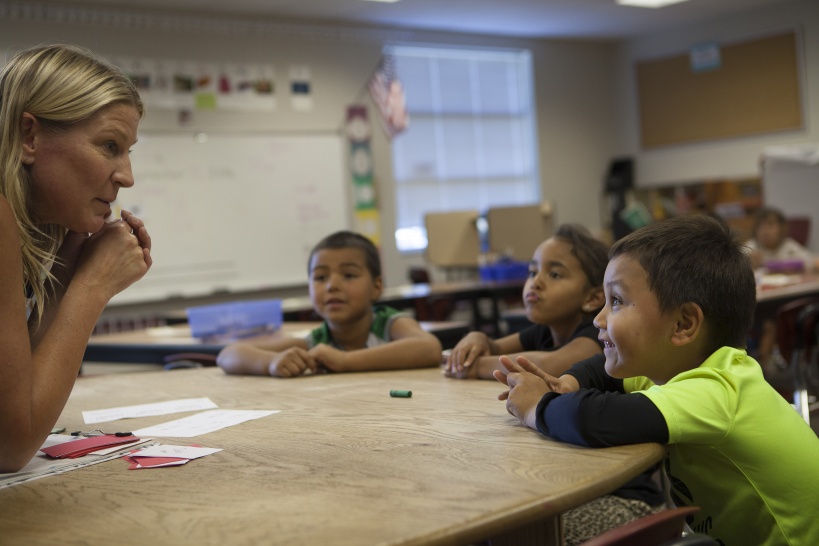
BIE students engage with their teacher

BIA Logo Indian Affairs - Office of Public Affairs
Media Contact: Interior_Press@ios.doi.gov
For Immediate Release: August 16, 2018

WASHINGTON – Earlier this month, Tara Mac Lean Sweeney, a prominent Alaskan leader and acclaimed businesswoman with the Arctic Slope Regional Corporation, was sworn in as the Department’s Assistant Secretary for Indian Affairs. Sweeney was nominated by President Donald J. Trump in October 2017. Sweeney, a member of the Native Village of Barrow and the Iñupiat Community of the Arctic Slope, is the first Alaska Native and only the second woman in history to hold the position.

The Assistant Secretary for Indian Affairs oversees Interior’s manifold responsibilities to enhance the quality of life, promote economic opportunity, and provide quality educational opportunities for American Indians, Indian tribes, and Alaska Natives, while protecting and improving their trust assets.

“Tara is a results-driven team leader and coalition builder who has an impressive combination of business acumen and service to her community,” Secretary of the Interior Ryan Zinke said. “Her lifelong active engagement in Native American policy development and her outreach, advocacy, and organization skills are the combination we need to carry out the President’s reform initiative for Indian Country. She will be a great asset to the Department."

“I am honored to be able to serve Indian Country in this capacity,” Tara Sweeney said. “My goal is to develop strong relationships with Tribes, Alaska Native corporations, and Native Hawaiian Organizations to work on innovative solutions for lifting up our communities. I am motivated to work with Indian Country to find efficiencies inside the Bureau of Indian Affairs, improve service delivery and culturally relevant curriculum in the Bureau of Indian Education, and create a more effective voice for Tribes throughout the Federal Government. I am humbled by the confidence President Trump and Secretary Zinke have shown in me and ready to serve.”

Sweeney grew up in rural Alaska and has spent a lifetime actively engaged in state and national policy arenas focused on advocating for responsible Indian energy policy, rural broadband connectivity, Arctic growth and Native American self-determination. She has served her Arctic Slope Regional Corporation and its subsidiaries in a variety of capacities for nearly two decades. The $2.6 billion corporation is the largest locally owned and operated business in Alaska, with about 13,000 Iñupiat Eskimo members and 12,000 employees worldwide. In her role as the Executive Vice President of External Affairs, she was responsible for all facets of government affairs and corporate communications. Her primary responsibilities include strategic policy and position development, implementation and execution; engagement with federal and state executive and legislative branches on improving policies affecting Indian energy, taxation, resource development, government contracting, broadband development and access to capital; as well as all facets of corporate communication as official company spokesperson, including stakeholder engagement and coalition building.

Sweeney also has served in leadership positions on numerous business and nonprofit boards at both the state and national level, including chair of the Arctic Economic Council from 2015 to 2017; co-chair of the Alaska Federation of Natives (2013); Coast Guard Foundation Board of Trustees; the University of Alaska Foundation Board of Trustees; FCC Advisory Committee on Diversity for Communications in a Digital Age; Analytical Services, Inc.; Kohanic Broadcast Corporation (parent to the first Native American-owned, publicly supported FM radio station); Cherokee Nation New Market Tax Credit Advisory Board (CNB Economic Development Company, LLC, beneficiary); Breast Cancer Focus, Inc.; and Arctic Power.

Among her honors, Sweeney -- a lifetime member of the National Congress of American Indians -- was crowned Miss NCAI in 1993 and traveled the country as an ambassador for the organization. In 2003, Governor Frank Murkowski recognized Sweeney’s passion for rural Alaska, appointing her to his cabinet as Special Assistant for Rural Affairs and Education. In 2008 she was honored as a “Top Forty Under 40″ business leader by the Alaska Journal of Commerce. In 2014 & 2017 her team won two Emmy® Awards from the Northwest Chapter of the National Academy of Television Arts & Sciences, for its IAM IÑUPIAQ commercial campaign 2014 and its 2017 long-format documentary titled, “True North, the Story of ASRC”. She also served as co-chair for Senator Dan Sullivan’s (R-AK) successful Senate campaign. In 2017 she was inducted into the Anchorage ATHENA Society, a program of the Anchorage Chamber of Commerce that encourages the potential of women as valued members and leaders of the business community.

Born to Dr. Bryan Mac Lean and the Late Representative Eileen Panigeo Mac Lean, Sweeney is the granddaughter of the Late May Ahmaogak Panigeo and the Late Henry Panigeo of Barrow. She is the great granddaughter of the Late Bert and Nellie Panigeo and Isabel and Dr. Roy Ahmaogak. She was raised, attended schools and lived most of her life in rural Alaska in villages from Noorvik to Wainwright, Barrow, Bethel, and Unalakleet. She graduated from Barrow High School in 1991. A 1998 graduate of Cornell University School of Industrial and Labor Relations with a Bachelor of Science Degree, Sweeney is married to Kevin, and together they have two children, Caitlin and Ahmaogak.

Through its Bureau of Indian Affairs (BIA) and Bureau of Indian Education (BIE), Interior provides services (directly or through contracts, grants or compacts) to 1.9 million American Indians and Alaska Natives. There are 573 federally recognized American Indian tribes and Alaska Native corporations in the United States. The BIE provides education services to about 42,000 Indian students. The Indian trust, co-managed by BIA and the Office of the Special Trustee, consists of 55 million surface acres and 57 million acres of subsurface mineral estate. More than 11 million acres belong to individual Indians and nearly 44 million acres are held in trust for Indian tribes. On these lands, the Department manages more than 122,817 revenue-producing leases. In conjunction with the Department of the Treasury, Interior also manages about $4.9 billion in Indian trust funds. In Fiscal Year 2016, $1.2 billion was received into and disbursed from tribal and individual Indian beneficiaries’ accounts.

For Immediate Release: August 16, 2018
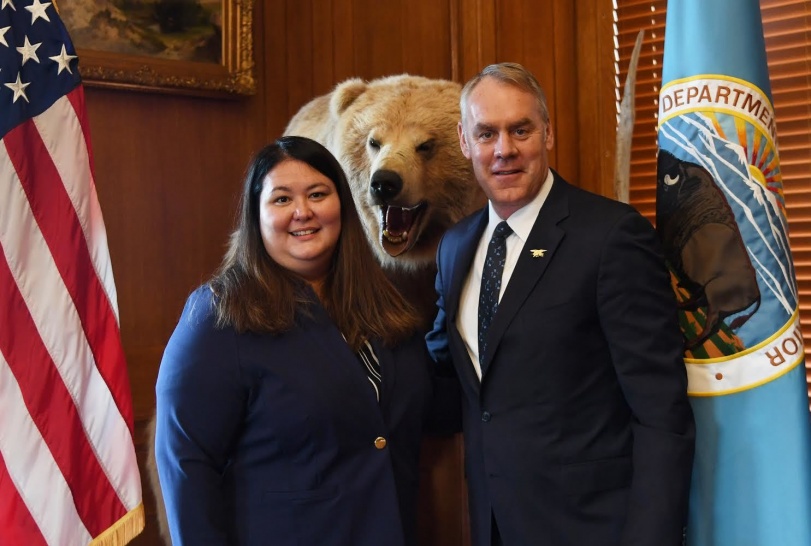
Secretary of the Interior Ryan Zinke with Assistant Secretary of Indian Affairs Tara Mac Lean Sweeney

indianaffairs.gov

An official website of the U.S. Department of the Interior

Looking for U.S. government information and services?
Visit USA.gov